Org. Synth. 2026, 103, 301-333
DOI: 10.15227/orgsyn.103.0301
Preparation of Cinnamyl carbamate and its Transformation to N-Protected 1-Phenylprop-2-en-1-amine Derivatives
Submitting Authors: Mariusz Zalewski and Sebastian Stecko*
1Checking Authors: Dong-Hang Tan, Yu-Ting Chen and Darren J. Dixon*
21. Procedure (Note 1)
A. Cinnamyl carbamate (2). An oven-dried, 500-mL, three-necked, round-bottomed flask equipped with a Teflon-coated magnetic stir bar (3 cm), thermometer (thermocouple), water-cooled condenser (with gas inlet and bubbler adapter), and inert gas inlet with stopcock at the side neck (Figure 1A) was charged with cinnamyl alcohol (1) (10.00 g, 74.5 mmol, 1.00 equiv) (Note 2), phenyl carbamate (15.33 g, 111.8 mmol, 1.5 equiv) (Note 3), and di-n-butyltin maleate (780 mg, 2.2 mmol, 3.0 mol%) (Note 4) through the side neck of the flask. After the stopcock adapter was replaced and the apparatus was purged with argon through the gas inlet for 15 min, 300 mL of dry toluene was added (Note 5) (Figure 1B and 1C), and the resulting mixture was heated at 90 °C (internal temperature, Note 6) for 3 h under a positive pressure of argon via a gas inlet. The progress of the reaction was followed by TLC analysis (Note 7). The resulting yellow solution (Fig. 1D, E) was cooled to room temperature (Note 8, 9), and aqueous NaOH (2 equiv, 5.84 g, 146 mmol, dissolved in 100 mL of water) (Note 10) was added. After stirring for 30 min, CH2Cl2 (150 mL) and H2O (200 mL) were added. The organic layer was separated, washed with 1 M aqueous solution of NaOH (1×50 mL), H2O (1×50 mL), and brine (1×50 mL), dried over anhydrous MgSO4 (150 g), and then concentrated in vacuo (Note 11,12,13) to provide 13.98 g of carbamate 2 (97% yield, 72.58 mmol) as a pale-yellow solid, with a 92% purity based upon qNMR analysis (Note 14).
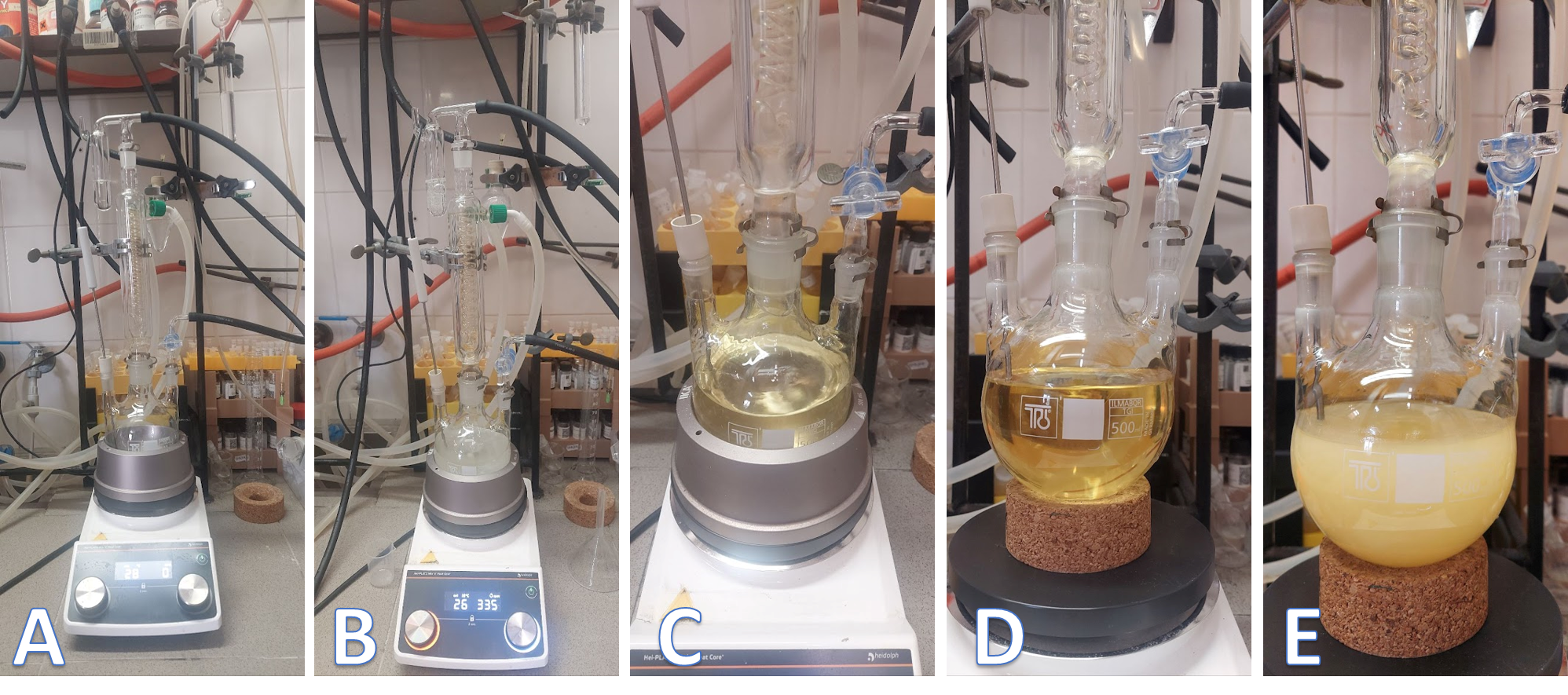
Figure 1. (A) The glassware setup for the reaction; (B) The reaction mixture just after the addition of the solvent; (C) The reaction mixture at the beginning of the heating; (D) The reaction mixture after 2 h at 90 °C; (E) The reaction mixture after cooling to room temperature (22 °C)
The resulting pale-yellow solid carbamate 2 (13.98 g) was dissolved in 60 mL of hot EtOAc and kept at reflux for 60 min. After 4 h, the crystalline product was collected by filtration through a Buchner funnel equipped with a paper filter (Note 15). The collected crystals were washed with a small amount of cold EtOAc (0-5 °C). The resulting mother liquor was reduced to one-half of its original volume. The precipitated product was redissolved by heating, and the resulting solution was left for a second crystallization (Note 16). To the remaining filtrate, 15 mL of cyclohexane was added to initiate the third crystallization process. The resulting precipitate (as a white powder) was collected by filtration through a Buchner funnel (Note 16). The collected crystal fractions were transferred to separate round-bottom flasks and kept in vacuo for 4 h (the 1st crop 4.76 g, the 2nd crop 3.98 g, and the 3rd crop 2.87 g) (Note 17). The total amount of the collected product 2 was 12.11 g (90% isolated yield) (Note 18, 19), with a purity of 100% as determined by qNMR (Note 14).
B. N-(1-phenylallyl)acetamide (3). In a 100-mL recovery flask, cinnamyl carbamate 2 (3.00 g, 16.93 mmol, 1.00 equiv) was dissolved in toluene (10 mL), and the solvent was removed azeotropically by rotary evaporation (70 mbar, 45 °C). After repeating this procedure two more times, and followed by drying under vacuum (5 × 10⁻² mbar) for 60 min, carbamate 2 was dissolved in dry THF (30 mL) (Note 20), then transferred by cannula to a 250-mL three-necked, round-bottomed flask equipped with a stir bar, a thermocouple connected to a digital thermometer, and an inlet adapter connected to an argon inlet. The flask was charged with dry THF (70 mL) (Note 20) and anhydrous triethylamine (10.28 g, 101.58 mmol, 14.16 mL, 6 equiv) (Note 21) (Figure 2A). The flask was cooled with an isopropanol/dry ice bath (internal temperature -15 °C, Figure 2B). Next, trifluoroacetic anhydride (7.11 g, 33.86 mmol, 4.7 mL, 2.00 equiv) (Note 22) was added using a 5 mL syringe (Note 23) at a rate that maintains the internal temperature below -10 °C (ca. 10 min) (Figure 2C). After the addition of the anhydride, the reaction mixture was kept at -10 °C for 20 min. Then the cooling bath was removed, and the resulting pale-yellow solution was stirred at room temperature for 40 min (Figure 2D).
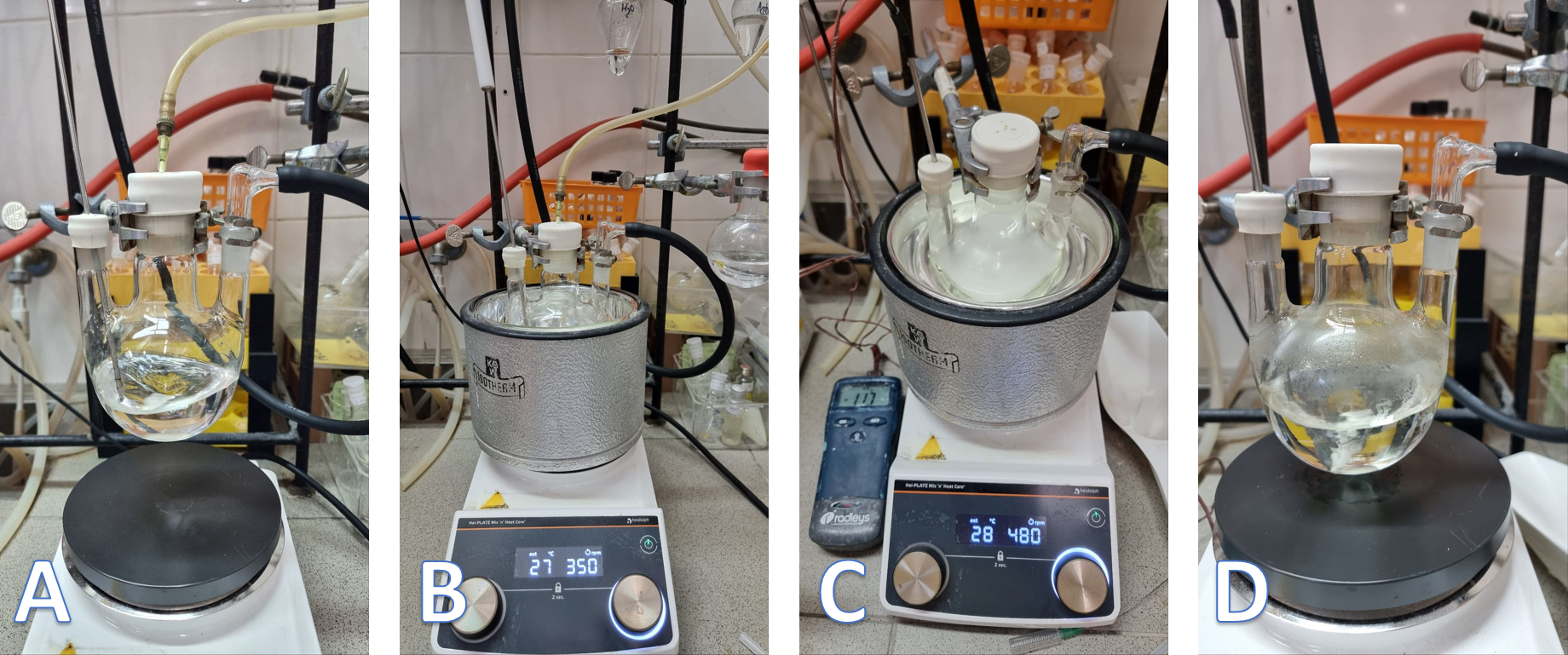
Figure 2. (A) The glassware setup for the reaction after addition of THF, carbamate 2, and Et3N; (B) The cooling reaction mixture before the addition of TFAA; (C) The reaction mixture after addition of TFAA at -10 °C; (D) The reaction mixture after removal of the cooling bath with continued stirring at room temperature under argon
After monitoring the disappearance of carbamate 2 by TLC analysis using 50:50 v/v EtOAc/n-hexane as eluent (ca. 50-60 min) (Note 24), the reaction mixture was again cooled with an acetone/dry ice bath (internal temperature -78 °C), a gas outlet connected with a bubbler was attached, and 33.9 mL of 3 M solution of MeMgBr (101.58 mmol, 6 equiv) (Note 25) was added slowly using a 20 mL syringe (Note 26) at a rate to maintain an internal temperature below -60 °C (ca. 10-15 min). During the addition, the reaction mixture became a milky white, turbid suspension (Figure 3A). After 30 min at -78 °C, the cooling bath was removed, and the reaction mixture was stirred at room temperature. During this time, the reaction mixture changed from white (Figure 3B) to pale-orange (Figure 3C).
Figure 3. (A) The reaction mixture (step 2) after addition of MeMgBr at -15 °C; (B) The reaction mixture after the removal of the cooling bath; (C) The reaction mixture after 2 h at room temperature
The disappearance of isocyanate intermediate was monitored by TLC analysis using 50:50 v/v EtOAc/n-hexane as eluent (Note 27). After a period of 120 min, the reaction mixture was transferred to a 500 mL separating funnel and diluted with EtOAc (200 mL) and water (100 mL). The aqueous phase was separated and treated with 1 M aq. HCl (150 mL), then extracted with EtOAc (2 × 100 mL). Subsequently, the combined organic layers were washed with sat. NaHCO3 (1 × 100 mL), brine (1 × 100 mL), and dried over anhydrous MgSO4 (250 g) in 1 L conical flask. After removal of the solvents and volatiles on a rotary evaporator (water bath temperature: 15 °C, 210 mbar to 100 mbar) (Note 28), the residual yellow-orange sticky liquid was subjected to silica gel column chromatography (Note 29). The combined fractions were concentrated on a rotary evaporator (water bath temperature: 40 °C, 210 mbar, to 15 mbar) and dried under vacuum (5 × 10⁻² mbar) to furnish 2.04 g of acetamide derivative 3 as a white solid (98.7% purity, 68% overall yield from 2) (Notes 30,31,32).
2. Notes
1. All glass apparatus was dried in an oven at 120 °C for 12 hours and cooled in a drying desiccator.
2.
Cinnamyl alcohol [CAS 104-54-1] (98%) was purchased from Alfa Aesar and was used as received.
3.
Phenyl carbamate [CAS 622-46-8] (98%) was purchased from Alfa Aesar and was used as received.
4.
Di-n-butyltin maleate [CAS 78-04-6] (99%) was purchased from TCI Chemicals and was used as received.
5.
Toluene was purchased from Honeywell (cat. no. 34494). This solvent was dried by using a Solvent Purification System (MBraun MB-SPS-5).
6. The reaction flask was placed into a metal heating mantle and heated by a magnetic stirrer hotplate. The temperature was controlled by a thermocouple element directly immersed in the reaction mixture.
7. The progress of the reaction was monitored by thin-layer chromatography (TLC) using Merck pre-coated 0.25 mm thick silica gel 60 F254 plates (cat. no. 1.05554). The plates were eluted with 50:50 v/v
EtOAc/hexanes and visualized with a UV lamp (254 nm), followed by dipping with Hanessian's stain or
KMnO4 stain and heating with a heat gun.
Rf = 0.7 (phenol); 0.5 (
cinnamyl alcohol 1), 0.3 (
phenyl carbamate 2) (Figure 4).
Figure 4. TLC monitoring of carbamoylation reaction of 1
8. The initially clear yellow solution turns cloudy when it cools to room temperature because the remaining
phenyl carbamate is not easily dissolved in
toluene. At this point the reaction mixture can be subjected to a work-up, or left overnight to start the work-up the next morning.
9. Room temperature throughout this manuscript refers to a temperature between 21 °C and 23 °C.
10. This step facilitates the removal of the phenol and an excess of
phenyl carbamate. Approx. 30 min is enough to remove the phenol and hydrolyze the remaining
phenyl carbamate. The longer exposure to the base resulted in partial hydrolysis of the produced carbamate.
11. Throughout this manuscript, a rotary evaporator R-300 purchased from BÜCHI Labortechnik AG was used, with a rotation rate of 180 rpm, and the temperature of the water bath was set to 40 °C. To remove the
toluene-
dichloromethane solvent mixture, the following drying method was used: 20 min at 400 mmHg, 20 min at 75 mmHg, 5 min at 25 mmHg.
12. The removal of the phenol can be followed by TLC analysis, as illustrated in Figure 5:
Figure 5. Purification of cinnamyl carbamate 2 (TLC monitoring)
13. If the combined aqueous layers still contain product, it is recommended to extract them with one (100 mL) or two more portions of
CH2Cl2.
14. The purity of product
2 was determined by
1H NMR
pdf spectra recorded in CDCl
3 with
1,3,5-trimethoxybenzene ([CAS 621-23-8], Sigma-Aldrich, cat. no. 138827, 99%) as an internal standard by checking authors.
15. A 70 mm diameter filter paper obtained from Fisher (range: QL100, cat. no. 11556873) was used in the filtration steps.
16. The collected crystals were washed with a small amount of cold
EtOAc (0-5 °C), and dried in vacuo (Figure 6). For drying, room temperature and pressure lower than 15 mmHg were maintained.
Figure 6. Isolated cinnamyl carbamate 2
17. The submitting authors reported that
2 can also be purified by flash column chromatography on silica gel, with
EtOAc and hexane mixtures as eluents and a gradient that goes from 1:5 to 1:0 v/v. However, if one carries out the synthesis of
cinnamyl carbamate 2 on a larger scale (over 3 g), recrystallization is recommended. During chromatography, compound 2 may crystallize on the silica gel, prolonging the purification process and necessitating more solvents to elute it from the column.
18. High vacuum was established with a vacuum oil pump provided by Vacuubrand GmbH & Co. KG. For drying, room temperature and pressure lower than 15 mmHg were maintained.
19. Spectral data for carbamate
2:
1H NMR
pdf (500 MHz, CDCl
3) δ 7.41 - 7.37 (m, 2H), 7.35 - 7.30 (m, 2H), 7.29 - 7.23 (m, 1H), 6.65 (dt,
J = 16.0, 1.5 Hz, 1H), 6.29 (dt,
J = 15.9, 6.4 Hz, 1H), 4.99 - 4.82 (m, 2H), 4.73 (dd,
J = 6.3, 1.4 Hz, 2H) ppm;
13C NMR
pdf (126 MHz, CDCl
3) δ 156.9, 136.4, 134.0, 128.7, 128.1, 126.7, 123.7, 65.8 ppm; HRMS (ESI) m/z calcd for C
10H
11NO
2Na [M+Na]
+ 200.0682; found 200.0684; FTIR (film)
ν 3418, 3332, 3273, 3204, 1682, 1629, 1603, 1412, 1344, 1116, 1052, 970, 746, 694 cm
-1; Elemental Anal. Calcd for C
10H
11NO
2: %C 67.78; %H 6.26; %N 8.06; found %C 67.65; %H 6.25; %N 8.02; M.p. 124-126 °C.
20.
Tetrahydrofuran (99.5%, Extra dry over molecular sieves) was purchased from Thermo Scientific (cat. no. 348450010).
21. Anhydrous
trimethylamine (99%) [CAS 121-44-8] was purchased from Sigma Aldrich (cat. no. 471283) (SureSeal
® Anhydrous Chemicals Series) and was used as received.
22.
Trifluoroacetyl anhydride (99%) [CAS 407-25-0] was purchased from Merck (cat. no. 8.08261) and was used as received.
23. The needle used for the syringe is 21 G (0.8 mm × 40 mm).
24. The progress of the first step was monitored by thin-layer chromatography (TLC) using Merck pre-coated 0.25 mm thick silica gel 60 F254 plates (cat. no. 1.05554). The plates were eluted with 50:50 v/v
EtOAc/hexanes and visualized with a UV lamp (254 nm), followed by dipping in Hanessian's stain and heating with heat gun.
Rf = 0.5 (
cinnamyl alcohol), 0.7 (cinnamyl isocyanate) (Figure 7).
Figure 7. TLC monitoring during synthesis of compound 3 (steps 1-2: dehydration and rearrangement)
25.
Methylmagnesium bromide (3M solution in
Et2O, AcroSeal
TM) [CAS 75-16-1] was purchased from Thermo Scientific Chemicals (formerly Acros Chemicals) (cat. no. 183548000) and was used as received.
26. The needle used for the syringe is 21 G (0.8 mm × 120 mm).
27. The progress of the second step was monitored by thin-layer chromatography (TLC) using Merck pre-coated 0.25 mm thick silica gel 60 F254 plates (cat. no. 1.05554). The plates were eluted with 50:50 v/v
EtOAc/hexanes and visualized with a UV lamp (254 nm), followed by dipping in Hanessian's stain and heating with a heat gun.
Rf = 0.5 (
cinnamyl carbamate), 0.7 (cinnamyl isocyanate), 0.3 (product
3) (Figure 8).
Figure 8. Synthesis of compound 3: TLC monitoring of step 1 and 2
28. It was observed that concentration at 40 °C led to a more complex TLC profile, suggesting that the target compound undergoes partial decomposition at this temperature (Figure 9).
Figure 9. Decomposition observed after crude concentration at 40 °C
29. The crude product
3 was dissolved in 30 mL of
dichloromethane. To this was added 20 g of Florisil (0.15-0.25 mm size, Merck, cat. no. 1.12518), and the solvent was removed under reduced pressure. The resulting crude product supported on Florisil was transferred to the silica gel column cartridge (180 mm × ø55 mm, Figure 9, filled with 220 g silica gel from Merck, cat. no. 1.09385; particle size 230-400 mesh) and subjected to gradient column chromatography using Reveleris X2 flash chromatography (eluent: 5%
EtOAc/
petroleum ether (
PE) for 6 min, then gradient from 5% to 60%
EtOAc/
PE for 15 min, and 60%
EtOAc/
PE for 24 min, flow 50 mL/min).
Figure 10. An empty flash chromatography cartridge used for purification of product 3
30. The purity of product
3 was determined by
1H NMR
pdf spectra recorded in CDCl
3 with
1,3,5-trimethoxybenzene ([CAS 621-23-8], Sigma-Aldrich, cat. no. 138827, 99%) as an internal standard [by checking authors]. The yield of product
3 is the overall isolated yield over 3 steps: dehydration of
cinnamyl carbamate to cyanate, [3,3]-sigmatropic rearrangement of allyl cyanate to allyl isocyanate, and nucleophilic addition to the isocyanate group.
31. The submitting authors reported that, after column chromatography, the purity of product
3 was 95.1%, which is sufficient for the majority of further applications. If a higher purity is required, the product can be dissolved in hot
methyl tert-butyl ether (
MTBE, 99%, [CAS 1634-04-4] purchased from Thermo Scientific Chemicals (no. cat. L14030-AU) and used as received) (1 mL/g), followed by addition of hexanes (0.5 mL/g), and left for a slow crystallization at room temperature. The most reproducible results (in terms of yield) were obtained when the crystallization was performed in a thermostatically controlled chamber at 23 °C; standard technique at ambient temperature is also suitable; however, the yield can be up to 6-10% lower (with unchanged purity) depending on the temperature in a laboratory. The collected crystalline product was washed with a small amount of cold
MTBE and dried under high vacuum (5 × 10
-2 mbar) for 5-6 h (to constant mass of the product) (Figure 11).
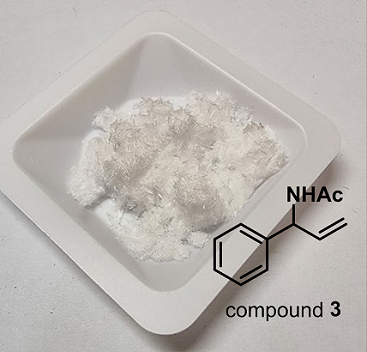
Figure 11. Isolated product 3
The submitting authors reported the yields and product purity of five independent experiments, which are summarized in the table below. When the purity of the product after column chromatography exceeded 98%, the additional crystallization step was omitted.
32. Spectral data for acetamide
3:
1H NMR
pdf (400 MHz, CDCl
3) δ 7.37 - 7.24 (m, 5H), 6.18 (d,
J = 7.8 Hz, 1H), 6.00 (ddd,
J = 17.1, 10.4, 5.3 Hz, 1H), 5.62 (m, 1H), 5.28 - 5.10 (m, 2H), 2.01 (s, 3H) ppm;
13C NMR
pdf (101 MHz, CDCl
3) δ 169.4, 140.6, 137.3, 128.8, 127.8, 127.4, 115.9, 55.3, 23.3 ppm; HRMS (ESI)
m/z calcd for C
11H
14NO [M+H]
+ 176.1070; found 176.1077; FTIR (film)
ν 3241, 3106, 3057, 2358, 2331, 1648, 1633, 1545, 1489, 1370, 1142, 992, 927, 842, 766, 699 cm
-1; Elemental anal. calcd for C
11H
13NO: %C 75.40; %H 7.48; %N 7.99; found %C 75.24; %H 7.44; %N 8.06; M.p. 62-64 °C.
Working with Hazardous Chemicals
The procedures in
Organic Syntheses are intended for use only by persons with proper training in experimental organic chemistry. All hazardous materials should be handled using the standard procedures for work with chemicals described in references such as "Prudent Practices in the Laboratory" (The National Academies Press, Washington, D.C., 2011; the full text can be accessed free of charge at
http://www.nap.edu/catalog.php?record_id=12654). All chemical waste should be disposed of in accordance with local regulations. For general guidelines for the management of chemical waste, see Chapter 8 of Prudent Practices.
In some articles in Organic Syntheses, chemical-specific hazards are highlighted in red "Caution Notes" within a procedure. It is important to recognize that the absence of a caution note does not imply that no significant hazards are associated with the chemicals involved in that procedure. Prior to performing a reaction, a thorough risk assessment should be carried out that includes a review of the potential hazards associated with each chemical and experimental operation on the scale that is planned for the procedure. Guidelines for carrying out a risk assessment and for analyzing the hazards associated with chemicals can be found in Chapter 4 of Prudent Practices.
The procedures described in Organic Syntheses are provided as published and are conducted at one's own risk. Organic Syntheses, Inc., its Editors, and its Board of Directors do not warrant or guarantee the safety of individuals using these procedures and hereby disclaim any liability for any injuries or damages claimed to have resulted from or related in any way to the procedures herein.
3. Discussion
Allylamines are versatile building blocks used in the synthesis of various naturally occurring products and pharmaceuticals. Traditionally, they are prepared by the nucleophilic addition of alkenylmetals to imines
3 (Scheme 1, path A) with all inconveniences connected with both strategies. On the other hand, the contemporary protocols, such as the reductive coupling
4 or alkylative coupling
5 of alkynes with imines (Scheme 1, path B), which often allow avoiding the use of sensitive alkenylmetals, still require
N-EWG groups to enhance imines' electrophilicity. Despite the progress, the coupling of abundantly available alkenes,
via hydroalkenylation of imines, remains scarce.
6 So far, it is limited to the introduction of styrene-like moieties.
7Scheme 1. Typical strategies for preparation of allylamines
Another typical strategy for the preparation of allylamines is transition-metal-catalyzed allylic amination or amidation reactions of allyl alcohols and their derivatives (Scheme 1, path C).
8 Although this strategy displays a broad scope of starting materials, as well as N-nucleophiles, it requires mostly the use of palladium or iridium complexes to achieve good yields and high regioselectivity.
An attractive alternative to already mentioned strategies is the preparation of allylamines through [2,3]- or [3,3]-sigmatropic rearrangement reactions of allyl alcohol derivatives (Scheme 1, path D). A typical representative of such methods for the preparation of allylamine derivatives is the Overman [3,3]-sigmatropic rearrangement of allyl alcohol-derived (
1) allyl trihaloacetimidates (
3) to the corresponding N-allyl trihaloacetamides (
2) (Scheme 2).
9,10 The Overman reaction is an allowed pericyclic reaction; however, it usually requires a high temperature (100-150 °C) to proceed. Moreover, the presence of a base (e.g., K
2CO
3)
11 is often recommended to improve the yields due to limited stability of imidates, which can be problematic in the case of base-sensitive substrates or products. An employment of catalytic conditions, in the presence of metal complexes (e.g. Pd,
12 Hg,
9b Au
13) allows to use less harsh conditions but still requires elevated temperatures (60-90 °C). Noteworthy, allyl trihaloacetimidates display limited stability and high acid sensitivity, which are significant disadvantages of their use and storage (preferably in a refrigerator in case of long-time storing).
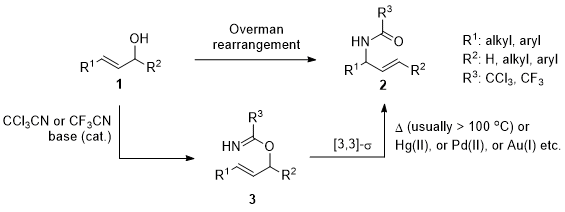
Scheme 2. The Overman rearrangement of allyl trihaloacetimidates
In 1991, Ichikawa and co-workers
14, 15 presented an alternative synthetic method for a conversion of allyl alcohols (
1) to the allylamine derivatives
4 based on the [3,3]-sigmatropic rearrangement of allyl cyanates (
6) to isocyanates (
7), also called the Ichikawa rearrangement (Scheme 3). The advantageous feature of the transformation of allyl cyanates to isocyanates is its spontaneous course and irreversibility. In the result, this rearrangement does not require high temperatures or a transition metal catalyst as for the mentioned Overmann rearrangement. The starting allyl cyanates (
6) are highly reactive species; thus, commonly they are generated
in situ. The first historical method relied on direct reaction of alkoxides with BrCN, however, such a process has very low efficiency.
15a Nowadays, they are prepared mostly by dehydration of allyl carbamates (
5), which are stable, usually crystalline, and easy-to-handle and store chemicals. Typically, they are synthesized by a treatment of allylic alcohols (
1) with trichloroacetyl isocyanate,
16 chlorosulphonyl isocyanate
17 or rarely trimetylsilyl isocyanate
18 (followed by hydrolysis of the intermediate product) (Kocovsky's protocol
19), as well as the disclosed here transcarbamolylation reaction.
20
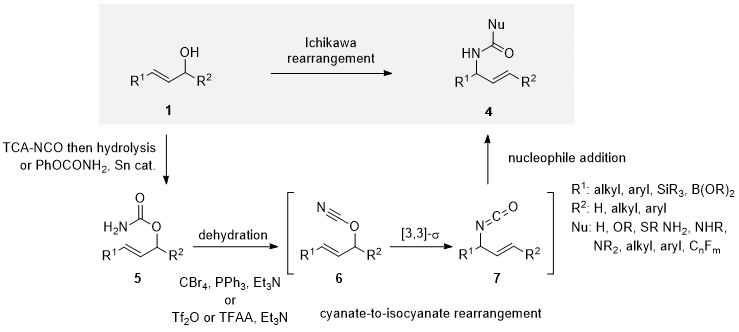
Scheme 3. The Ichikawa rearrangement (TCA = trichloracetyl, TFAA = trifluoroacetic anhydride)
In most cases both methods, addition to isocyanate/hydrolysis or transcarbamoylation, are complementary and can essentially be used interchangeably. However, sometimes it is not true, and the isocyanate-based protocol fails. A good example is a preparation of carbamate
10 from alcohol
8 by Ichikawa and co-workers (Scheme 4).
20a Their several attempts to accomplish this transformation using Kocovsky's protocol were unsuccessful due to peculiar nature of 3,3'-disubstituted secondary allyl alcohols and their derivatives (e.g.,
9), which in some cases are strongly susceptible to solvolysis reactions.
21 On the other hand, a preparation of
10 through Sn-catalyzed transcarbamoylation of alcohol
8 with phenyl carbamate resulted in an acceptable 72% yield. We observed the same tendency in case of preparation of structurally related cyclic allyl carbamates (bearing substituents other than Me attached to C-3 positions).
22 Another unusual example is a synthesis of carbamate
12 starting from alcohol
11.
23 Under Kocovsky's conditions only traces of product
12 were noticed, along with a complex mixture of unidentified side products. Under transcarbamoylation conditions, using 20 mol% of the tin complex, the yield was improved to 50%. It is worth stressing one more uniqueness of carbamate
12 here. Unlike compound
10, the synthesis of its isomers, differing in the position of the MeO group at the phenyl ring, by standard treatment of the corresponding alcohols with trichloroacetyl isocyanate proceeded without any problems, and the expected products were isolated in 70-86% yield. So, the observed anomaly concerned only compound
11.
23
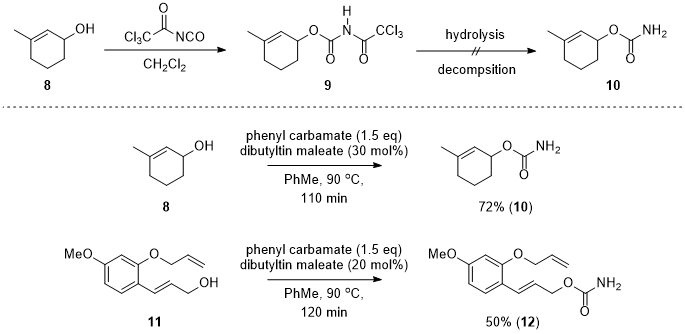
Scheme 4. The examples of problematic synthesis of allyl carbamates
As outlined in Scheme 3, the transformation of allyl carbamate
9 to allylamine derivative
12 involves three subsequent steps: dehydration of carbamate
9 to cyanate
10, sigmatropic rearrangement of allyl cyanate
10 to allyl isocyanate
11, and nucleophilic addition to the latter one to furnish product
12. All steps are commonly realized in a one-pot manner without isolation of the isocyanate intermediate. The dehydration reaction is rapid, similarly to subsequent spontaneous rearrangement, and usually both steps take 20-60 min. Contrary to the Overmann reaction, these two steps proceed under very mild conditions (-15 to 0 °C) and without assistance of a metal catalyst. Moreover, the rate of dehydration/rearrangement is high enough even at lower temperatures; for example, both steps process smoothly even at -78 °C. It is an important feature, especially in case of sensitive substrates, like in case of a rearrangement of cyclopropenylcarbinyl cyanates investigated by the Cossy group.
24Two commonly used protocols for the dehydration of allyl carbamate to cyanate were proposed by Ichikawa.
14, 16 In the first one, the starting carbamate is treated with Tf
2O in the presence of an amine (e.g., Et
3N or DIPEA). In the second protocol, the combination of CBr
4/PPh
3 in the presence of an amine (e.g.,
Et3N or DIPEA) is employed.
14, 16 Although both methods are very efficient, they also have some disadvantages. A use of relatively expensive and highly reactive Tf
2O is a serious limitation of the first method, whereas low atom economy and the necessity to manage large amounts of waste (like phosphine oxide, CHBr
3) are key drawbacks of the latter one. Therefore, the disclosed here conditions in which allyl carbamate is initially dehydrated by treatment with trifluoroacetic anhydride in the presence of base (e.g., Et
3N) seem to be the most attractive, bearing in mind the cost of the reagents and simplicity of an extractive removal of side products (trifluoroacetic acid salts mostly).
It must be emphasized that a significant advantage of allyl cyanate-to-isocyanate rearrangement over the related transformations relies not only on availability, stability of starting materials, and mild reaction conditions but also on the formation of the isocyanate product. For example, contrary to the Overmann reaction, which allows for the transformation of trihaloacetimidates to N-allyl trihaloacetamides only, Ichikawa's transformation enables the preparation of a variety of N-functionalized allylamine derivatives just by reacting the isocyanate intermediate with various nucleophilic reagents (Scheme 3).
Trapping with O- and S-nucleophiles. As we demonstrated herein, the generated isocyanate can be trapped with alkoxides to furnish the corresponding
N-allyl carbamates. For example, a use of
tert-butanol, benzyl alcohol, 2,2,2-trichloroethanol, or allyl alcohol allows for a direct and rapid preparation of
N-Boc,
16,25 N-Cbz,
16,25 N-Troc,
26 and
N-Alloc
26 protected allylamines, respectively. An installation of Fmoc group is also possible;
27 however, it requires extractive isolation of isocyanate intermediate
7 product prior to an addition of 9-fluorenemethanol. Otherwise, the triethylamine present in the reaction mixture will subsequently remove the
N-Fmoc protecting group. Typically, alkoxides are used as O-nucleophiles, which are prepared
in situ by the treatment of the corresponding alcohol with a base such as lithium hexamethyldisilazide or
n-BuLi. However, since such alkoxides are also strong bases, they have to be used with high care especially for base-sensitive compounds bearing base-sensitive functional groups, or epimerization-prone stereogenic centers. Presented in Scheme 5 synthesis of
N-Boc-protected allylamine
15 is an excellent example to explain required caution.
As already discussed, treatment of allyl carbamate 13 with TFAA/Et3N provides the corresponding allyl isocyanate 14 through a dehydration/rearrangement reaction sequence. Unfortunately, its treatment with t-BuOLi in THF at -30 °C does not furnish the expected allylamine 13 but the isomeric product 16 with a double bond shifted toward the phenyl ring as presented in Scheme 5. The same course is observed when t-BuOLi is added to crude isocyanate or when isocyanate solution is added slowly to t-BuOLi. Further decrease of the reaction temperature (to -50 °C or even to -78 °C) does not change the reaction course, and again compound 16 is the dominant one along with traces of the desired product 15. The most plausible explanation for this phenomenon is presented in Scheme 5. Due to the high acidity of hydrogen atom C-1, compound 15 is deprotonated in the presence of an excess of t-BuOLi to provide allylic anion 17 and tert-butanol. The latter one is in an equilibrium with the anion 18, which is a strong base capable of deprotonating the previously formed tert-butanol, regenerating the nucleophile, and affording the undesired isomeric product 16 (Scheme 5).
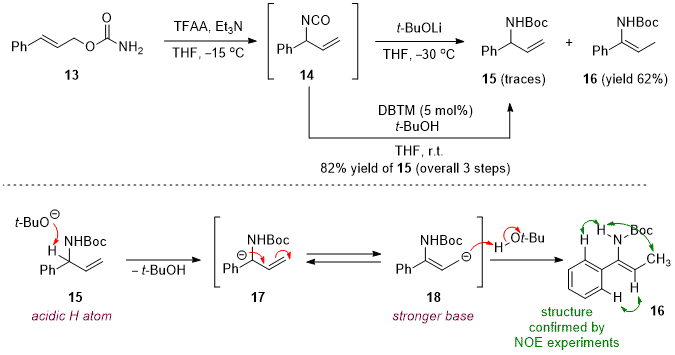
Scheme 5. Base-mediated side isomerization of allylamine derivatives during the Ichikawa rearrangement
Therefore, to avoid any kind of base-mediated isomerization, it is more convenient to treat intermediate isocyanate with a less nucleophilic alcohol in the presence of a Bronsted or Lewis acid, such as MeOSn(
n-Bu)
3,
28 dibutyltin dilaurate or maleate,
29 Ti(O
t-Bu)
4,
30 TMSCl,
31 MoO
2Cl
2,
32 or nucleophilic catalysts like DBU.
33It is worth noting that the possibility of subsequent isomerization in the presence of alkoxylates is highly dependent on the electronic structure of the forming
N-protected allylamine. For example, although the aforementioned isomerization was observed in the case of allylamine
3, such a process did not occur in the case of analogues, the synthesis of non-racemic allylamines like compound
23 from optically active carbamates
22 (Scheme 6). The structures of the obtained products were confirmed using NMR spectra,
34 while simultaneously demonstrating the absence of racemization of the obtained allylamines through HPLC analysis using chiral columns.
The same, expected outcome was observed in the case of the rearrangement of other non-racemic allyl carbamates, like compounds
19,
21,
23 and
25 (Scheme 6).
25 In all cases, the dehydration/rearrangement/addition sequence proceeded without racemization and a double bond isomerization in the product. The double bond migration was not observed in cyclic systems such as compounds
27/
28,
35 or for allyl carbamate
29 which was transformed into
30 in excellent yield.
23Scheme 6. Examples of Ichikawa rearrangement of allyl carbamates followed by trapping of isocyanate with alkoxides
Generally, the generated allyl isocyanate can be treated also with water, as a nucleophile, to provide free allylamine. However, from a practical point of view, such an approach has low efficiency and is used rarely due to the low rate of the addition. Consequently, the generated free allylamine rapidly attacks unreacted isocyanate to provide undesired bis-
N,N'-allylated urea. More efficient strategies rely on the addition of water to isocyanate in the presence of acid or a large excess of hydroxide anion. However, if strong acidic or basic conditions have to be avoided, free allylamine can be prepared by an indirect method by trapping of the isocyanate with TMSOLi, to provide a Si-containing Boc group analogue and its subsequent desilylation mediated by F-anions leading to free amine, e.g., compound
31 (Scheme 7).
28a, 36Scheme 7. Synthesis allylamine 31
Additionally, upon treatment with aliphatic or aromatic thiols (or their salts) allyl isocyanates deliver the corresponding tiocarbamates (
e.g. 32, Scheme 8).
23, 37Scheme 8. Synthesis of S-Bn carbathiomate 32
Trapping with C-nucleophiles. The treatment of
in situ generated allyl isocyanate with Grignard or organolithium reagents allows for a direct synthesis of
N-allyl amides. Since organomagnesium and organolithium reagents are also strong bases, they can be replaced by less aggressive reagents such as organozinc ones.
38 Acetamides can be readily prepared by the use of organoaluminium reagents, e.g. Me
3Al.
39 Addition of lithium carbenoids to isocyanates enables efficient synthesis of synthetically useful
N-substituted 2-haloacetamides.
40
Trapping with H-nucleophiles. The treatment of allyl isocyanates with hydride-type nucleophiles, such as NaBH
4,
28,41 LiBH
4,
42 LiBHEt
3,
43 enables hydride transfer to the isocyanate moiety, providing the corresponding
N-allyl formamide derivatives. Pace and co-workers
44 demonstrated that Schwartz's reagent can also serve as a suitable hydride donor for such addition. When a stronger reagent, such as LiAlH
428a,45 is applied, the isocyanate functionality is reduced to methylamine one, as it was demonstrated by Chen and Lu
45a in their total synthesis of ketamine and norketamine.
Trapping with N-nucleophiles. An addition of primary or secondary amines to the allyl isocyanate delivers
N-allyl substituted ureas (Scheme 9).
22,23,28,37b,46 The addition proceeds smoothly even in the case of more hindered α-secondary (e.g.,
i-PrNH
2) and α-tertiary amines (e.g.,
t-BuNH
2). The addition of anilines is much slower due to their lower nucleophilicity in comparison to aliphatic amines. Additionally, pyrrole-type aromatic heterocycles can be used as a
N-nucleophile to afford
N-carbamoylated heterocycles.
47 In the presence of ammonia, the urea derivative
33 is formed (Scheme 10). Hydroxylamine and its
O-functionalized derivatives give type
34 urea derivatives (Scheme 9). Similarly, an interception of allyl isocyanate with hydrazine leads to product
35 (Scheme 9). In the case of mono-substituted hydrazines, the regioselectivity of addition depends on the electronic nature of the substituents. The presence of
N-aryl
48 and
N-EWG
49 groups at one of the hydrazines' nitrogen atoms makes the terminal NH
2 group more reactive, whereas electron-donating ones increase the nucleophilicity of the internal nitrogen atom (Scheme 10).
50
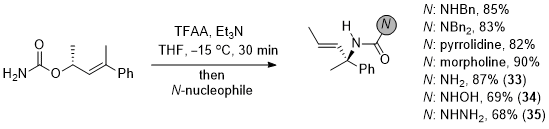
Scheme 9. Synthesis of urea derivatives via Ichikawa's rearrangement
Scheme 10. Regioselectivity of hydrazine addition to allyl isocyanates
The rearrangement of allyl cyanates is very efficient for the synthesis of sterically congested allylamine derivatives, whose preparation by other methods is challenging or even impossible. In such cases, dehydration/rearrangement of allyl carbamates bearing highly substituted double bond functionality proceeds slower, resulting in the formation of hindered isocyanates displaying a lower reactivity, particularly with weak or non-charged nucleophiles. A typical example of such transformation is Ichikawa's synthesis of carbamate
37 from geraniol-derived carbamate
36 presented in Scheme 11.
16Scheme 11. Ichikawa's synthesis of geraniol-derived allylamine 37
Thanks to the concerted mechanism of the cyanate-to-isocyanate rearrangement, proceeding through a 6-membered cyclic transition state, transformation of enantiomerically enriched allyl carbamates is stereospecific and provides non-racemic allylamine derivatives with a complete 1,3-transfer of stereochemistry.
3c,15a,45b The origin of that is the lower energy transition state
38, which leads to the isocyanate with a
E-double bond (Scheme 12). By contrast, the
Z-isomer is not observed, undoubtedly due to the A
1,3 strain incurred in the alternative transition state
39. Consequently, thanks to stereospecificity of the rearrangement, a preparation of single enantiomers of allylamine is possible starting from the corresponding carbamates if the suitable method for the preparation of enantiomerically pure allyl carbamates is available (Scheme 13).
Scheme 12. Stereospecifity of the cyanate-to-isocyanate rearrangement
Scheme 13. Stereogenic center-controlled synthesis of enantiomeric allylamines
However, what if only one enantiomer of allyl alcohol is available? Such a problem is typical in syntheses based on natural chiral compounds (D-carbohydrates, L-amino acids, hydroxy acids, terpenes, and alkaloids) (chiral pool approach). Again, the solution is hidden in the concerted mechanism of sigmatropic rearrangement. Therefore, the rearrangement of two allyl carbamates, e.g.,
40 and
41 (both prepared from L-lactic acid), having the same absolute configuration of the stereogenic center but different geometry of a double bond, delivers enantiomeric products
42 and
ent-42 as illustrated in Scheme 14.
28a,51 As already mentioned and emphasized, their enantiomeric enrichment is related to the enantiomeric purity and the double bond geometric purity (E/Z ratio) in the starting allyl carbamate.
Scheme 14. Double bond geometry-controlled synthesis of enantiomeric allylamines
The transformations presented in Schemes 13 and 14 draw attention to a significant and challenging issue related to the discussed sigmatropic rearrangement process. Namely, in the case of the synthesis of starting non-racemic allyl carbamates, precise control of both the enantiomeric purity of the stereogenic center and the geometry of the double bond. Otherwise, minor contamination of optically active carbamate with the second enantiomer, or a small amount of the second geometric isomer, will result in a significant decrease of the enantiomeric purity of the resulting allylamine derivative (Scheme 14).
In summary, easy access to allyl cyanates via the dehydration of allyl carbamates, combined with the stereoselective characteristics of the sigmatropic rearrangement, demonstrates that the allyl cyanate-to-isocyanate rearrangement is an effective approach for the enantioselective production of allylamine derivatives. Consequently, a number of synthetic organic chemists have utilized this process for the synthesis of nitrogen-containing compounds, including naturally occurring compounds as well as bioactive molecules and drugs.
14, 15b, 17, 23, 24, 26, 28b, 35, 45a
Appendix
Chemical Abstracts Nomenclature (Registry Number)
Cinnamyl alcohol; (1) (104-54-1)
Phenyl carbamate; (622-46-8)
Di-n-butyltin maleate; (78-04-6)
Triethylamine; (121-44-8)
Trifluoroacetyl anhydride (407-25-0)
Methylmagnesium bromide (75-16-1)
|
Mariusz Zalewski received his M.Sc. degree in Chemical Technology from the Silesian University of Technology in 2017. In 2022, he obtained his Ph.D. in Organic Chemistry, also from the same university. After completing his Ph.D., he joined the Sebastian Stecko group at the Institute of Organic Chemistry of the Polish Academy of Sciences as a postdoctoral fellow. His research interests focus on organic synthesis methodology, photochemistry, mechano-chemistry, and catalysis. |

|
Sebastian Stecko received M.Sc. degree in Chemical technology from Silesian University of Technology in 2004. In 2008, he obtained his PhD in Organic Chemistry from the Institute of Organic Chemistry of the Polish Academy of Sciences. After short stays in France (Grenoble and Nantes) the joined Prof. Siegfried Blechert's group at the Technical University in Berlin as a post-doctoral fellow (Alexander von Humboldt fellowship). In 2011, he returned to Poland and started his independent career. His research interests are focused on organic synthesis methodology, pericyclic reactions, photo-, electro-, and mechanochemistry, catalysis, and total synthesis. |
|
Dong-Hang Tan received his B.Sc. degree in Pharmaceutical Science from Sun Yat-Sen University in 2015. In 2020, he obtained his Ph.D. in Medicinal Chemistry from the same university under the supervision of Professor Honggen Wang. After completing his Ph.D., he carried out postdoctoral research at Sun Yat-Sen University, followed by positions at Stony Brook University with Professor Jeffery Lipshultz. He is currently a Marie Skłodowska-Curie Actions Postdoctoral Fellow in the group of Professor Darren Dixon. |
|
Yu-Ting Chen began his research career as an undergraduate researcher at The Hong Kong Polytechnic University under the supervision of Professor Wing-Yiu Yu. He subsequently worked as a research assistant with Professor Tiow-Gan Ong at the Institute of Chemistry, Academia Sinica. He received his M.Sc. degree in Catalysis from Imperial College London in 2024 under the supervision of Professor Chris Braddock and Dr. Rob Davies. He later joined the Dixon group, where his current research focuses on the development of novel methodologies for the functionalization of amides. |

|
Professor Darren Dixon studied at the University of Oxford, where he received his Master's degree in 1993, and his DPhil in 1997 for work supervised by Prof Stephen G. Davies. After postdoctoral work with Professor Steven V. Ley CBE FRS, he joined the faculty at the Department of Chemistry in Cambridge in 2000. In 2004 he took a Senior Lecturership at The University of Manchester and in 2007 he was promoted to Reader. In 2008 he moved to his current post at the University of Oxford where he is Professor of Chemistry and is the Knowles-Williams Tutorial Fellow in Organic Chemistry at Wadham College. |
Copyright © 1921-, Organic Syntheses, Inc. All Rights Reserved