Org. Synth. 2026, 103, 121-134
DOI: 10.15227/orgsyn.103.0121
Intermolecular Hydroamination of Benzotriazole with Tetramethylethylene
Submitting Authors: Flora Fan, Emily R. Wearing, Cameron B. Loughney, and Abigail G. Doyle*
1Checking Authors: Robert Gaston, Jr. and Dirk Trauner*
21. Procedure (Note 1)
1-(1,1,2-Trimethylpropyl)-1H-benzotriazole (3). A single-necked (14/20 joint) 100-mL Schlenk flask equipped with a Teflon-coated magnetic stir bar (2.0 x 0.8 cm, rod-shaped) was flamed-dried under vacuum, and backfilled with argon (Note 2). The flask was charged with the solid reagents: 1H-benzotriazole (1, 1.79 g, 15.0 mmol, 1.0 equiv) (Note 3), tricyclohexylphosphine (0.48 g, 1.5 mmol, 0.10 equiv) (Note 4), and the [Ir(dF(Me)ppy)2(dtbbpy)]PF6 photocatalyst (0.078 g, 0.078 mmol, 0.05 equiv.) (Note 5) while maintaining a stream of argon to the Schlenk flask (Figure 1A). α,α,α-Trifluorotoluene (35 mL) (Note 6) and tetramethylethylene (2, 3.83 g, 5.40 mL, 45.4 mmol, 3.0 equiv) (Note 7) were added sequentially via a 6 mL syringe equipped with an 18-gauge needle, creating a bright-yellow suspension. 2,4,6-Triisopropylbenzenethiol (354 μL, 0.354 g, 1.5 mmol, 0.10 equiv) (Note 8) was added using a P1000 micropipette, by quickly removing the septum while maintaining a stream of argon. The septum was replaced, sealed, and secured with the aid of electrical tape. The flask was clamped above a stirring plate and positioned between two 427 nm PR160L Kessil lamps at a distance of 2 cm. The reaction was irradiated at 100% intensity with stirring (500 rpm) for 16 h (Figure 1B).
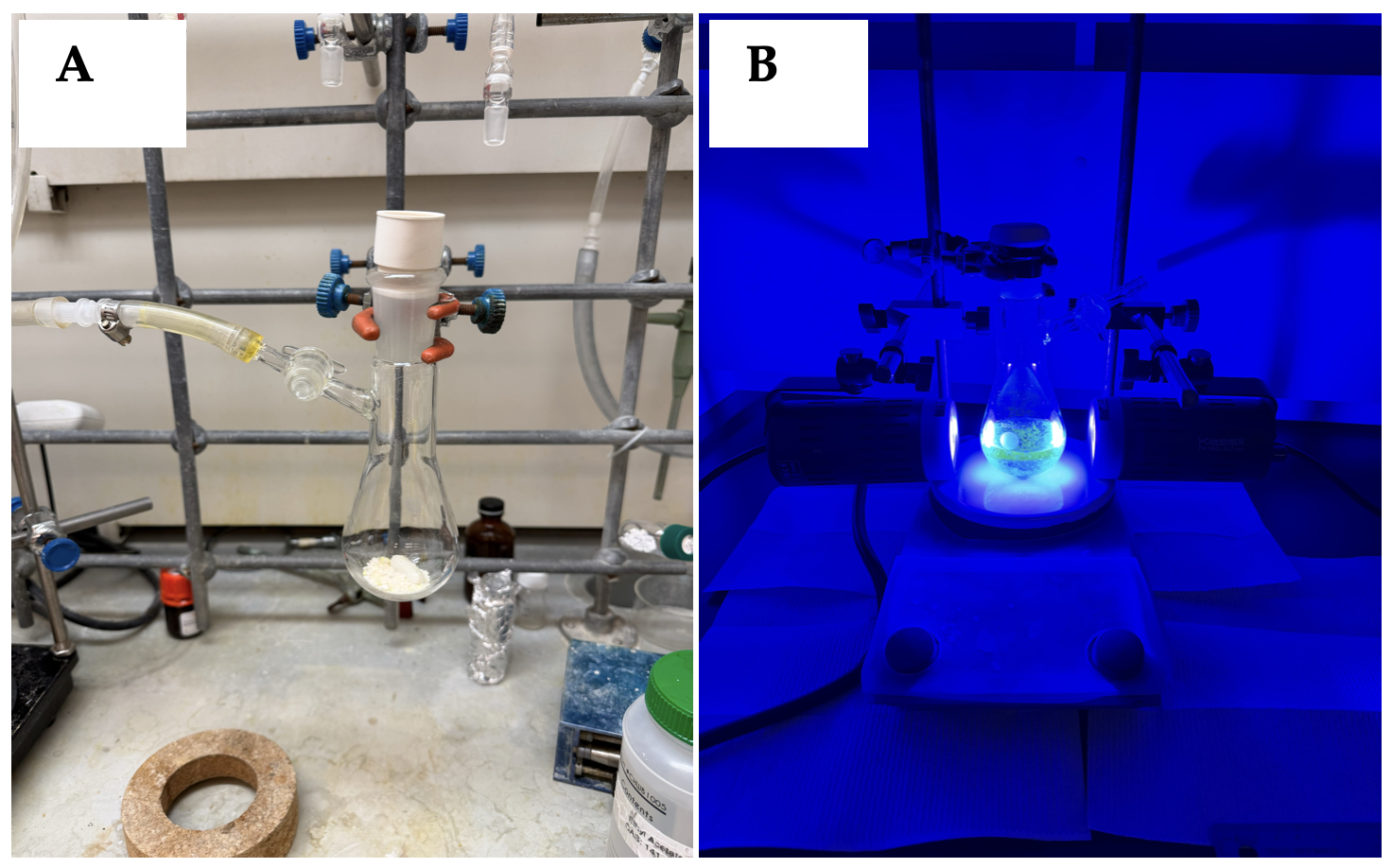
Figure 1 A. Schlenk flask with stir bar and reagents showing the argon inlet to maintain positive argon pressure; B. Reaction flask is irradiated at 427 nm with two 427 nm Kessil Lamps PR160L (photos provided by checkers)
After 16 h, the reaction mixture is a golden-brown solution (Figure 2A). The temperature was measured using an infrared thermometer to be 50-54°C. The flask was removed from irradiation, opened to the air, and transferred to a 100-mL pear-shaped flask with the aid of 15 mL of dichloromethane (3 x 5 mL, Note 9). The solvent was removed by rotary evaporation (40°C, 300-10 mm Hg) to give the crude material as a brown oil. TLC analysis of the reaction mixture showed the presence of product 3 at Rf = 0.20 (hexanes:ethyl acetate 7:1, Note 10).
Figure 2. A. Crude reaction post-irradiation; B. Crude golden-brown oil after concentration; C. chromatography (photos provided by checkers)
The crude oil (Figure 2B) is purified by flash column chromatography using a 5 cm diameter column plugged with cotton, then a layer of sand (2 cm), silica gel (25 cm, approx. 190 g) (Figure 2B, Note 11). This column is conditioned with hexanes until the silica gel appears tightly packed with no air pockets (approx. 900 mL) (Note 12), and the surface is level. The crude material is dissolved in dichloromethane (5 mL) (Note 9) and transferred onto the compacted column with a pipette. The flask is rinsed 2-4 times with dichloromethane (1-5 mL each rinse) and the washings are added to the column. Once adsorbed, sand (2 cm) is added to protect the silica (Figure 2C). The column is eluted with 2.0 L of a 7:1 hexanes:ethyl acetate solvent mixture (Note 13). The tubes containing pure product are collected (Note 14) in a 500 mL round-bottomed flask and concentrated on a rotary evaporator (40°C, 300-10 mm Hg) to afford a pale-yellow oil which solidified to an off-white solid upon subjecting to high vacuum. The solid is kept under high vacuum at room temperature (25 °C) for 8 h to afford 1-(1,1,2-trimethylpropyl)-1H-benzotriazole (3, 2.05 g, 72% yield) (Figure 4, Notes 15, 16) with 98% purity, as determined by qNMR analysis (Notes 17,18,19).
2. Notes
1. Prior to performing each reaction, a thorough hazard analysis and risk assessment should be carried out with regard to each chemical substance and experimental operation on the scale planned and in the context of the laboratory where the procedures will be carried out. Guidelines for carrying out risk assessments and for analyzing the hazards associated with chemicals can be found in references such as Chapter 4 of "Prudent Practices in the Laboratory" (The National Academies Press, Washington, D.C., 2011; the full text can be accessed free of charge at
https://www.nap.edu/catalog/12654/prudent-practices-in-the-laboratory-handling-and-management-of-chemical. See also "Identifying and Evaluating Hazards in Research Laboratories" (American Chemical Society, 2015) which is available via the associated website "Hazard Assessment in Research Laboratories" at
https://www.acs.org/about/governance/committees/chemical-safety.html. In the case of this procedure, the risk assessment should include (but not necessarily be limited to) an evaluation of the potential hazards associated with
1H-benzotriazole,
tricyclohexylphosphine,
Ir[dF(Me)ppy]2(dtbbpy)PF6,
tetramethylethylene,
2,4,6-triisopropylbenzenethiol,
α,α,α-trifluorotoluene, hexanes as a mixture of isomers,
ethyl acetate,
dichloromethane, silica gel,
1,3,5-trimethoxybenzene, and
CDCl3, as well as the proper procedures for the operation of 427 nm Kessil Lamps.
2. All reactions were conducted in flame- or oven-dried glassware under an argon atmosphere.
3.
1H-Benzotriazole (≥99%) was purchased from Sigma-Aldrich and was used as received.
4.
Tricyclohexylphosphine (97%) was purchased from Strem Chemicals and used as received.
5.
Ir[dF(Me)ppy]2(dtbbpy)PF6 (97%) was purchased from Ambeed and used as received.
6. Anhydrous
α,α,α-trifluorotoluene (≥99%) was purchased from Sigma-Aldrich and used as received.
7.
tetramethylethylene, or
2,3-dimethyl-2-butene (≥99%), was purchased from Sigma-Aldrich and used as received. A small scale (0.1 mmol) reaction employing fewer equivalents (1.5 equiv.) of this alkene resulted in a significantly decreased yield (12% yield by
1H NMR).
8.
2,4,6-Triisopropylbenzenethiol (97%) was purchased from Ambeed and used as received.
9.
Dichloromethane (≥99.5%) was purchased from Sigma-Aldrich and used as received.
10. TLC analysis of the reaction mixture is shown below (Fig. 3). The TLC plate was eluted with 7:1 hexanes:
ethyl acetate and visualized using 254 nm UV light.
Figure 3. The reaction mixture shows primarily the desired product (3), Rf = 0.20 (photo provided by authors)
11. Silica gel (230-400 Mesh, Grade 60) was purchased from Fisher Scientific and used as received.
12. Hexanes as a mixture of isomers (≥99.7%) was purchased from Sigma-Aldrich and used as received.
13.
Ethyl acetate (≥99.7%) was purchased from Sigma-Aldrich and used as received.
14. The material was collected in 18 x 150 mm test tubes (27 mL per fraction). Fractions containing the product were identified by TLC analysis (using hexanes/
ethyl acetate (7/1, v/v) as eluent, where the product (
3) has an R
f of 0.20. In the first run, fractions 39-60 contained the desired product, with UV active impurities eluting before (Fractions 18-30). In the second run, fractions 42-67 contained the desired product, with fractions 36-40 prior containing a UV active impurity above the product spot. Each test tube was washed 1-3 times with
EtOAc (1 mL) to ensure quantitative transfer.
15. All NMR analysis was performed using
chloroform-D (99.8%) obtained from Cambridge Isotope and used as received.
16. Characterization data of
3:
1-(1,1,2-trimethylpropyl)-1H-Benzotriazole, white solid; mp: 47.8-48.7°C; R
f = 0.20 in (hexanes:
ethyl acetate, 7:1; IR
pdf (neat): 2968, 2941, 2878, 1610, 1583, 1450, 1373, 1281, 1237, 1181, 1088, 1048, 1007, 919, 783, 742 cm
-1;
1H NMR
pdf (600 MHz,
CDCl3) δ 8.06 (dt,
J = 8.2, 1.0 Hz, 1H), 7.72 (dt,
J = 8.4, 0.9 Hz, 1H), 7.40 (ddd,
J = 8.4, 6.9, 1.1 Hz, 1H), 7.32 (ddd,
J = 8.0, 6.9, 0.9 Hz, 1H), 2.62 (hept,
J = 6.8 Hz, 1H), 1.84 (s, 6H), 0.80 (d,
J = 6.7 Hz, 6H) ppm;
13C NMR
pdf (151 MHz,
CDCl3) δ 147.2, 132.2, 126.5, 123.4, 120.4, 112.4, 67.1, 37.0, 24.2, 17.5 ppm.
Figure 4. Purified product 3 (photo provided by authors)
17. The purity of product
3 was determined by
1H qNMR analysis.
1H qNMR
pdf was performed using a mixture of
3 (15.1 mg) and
1,3,5-trimethoxybenzene (14.8 mg) (Sigma-Aldrich, ≥99.9%, as an internal standard) in
CDCl3. The purity was calculated according to the standard method as 98 wt%.
18. A second run provided 2.13 g of
3 (75% yield) and with 96% purity by qNMR.
19. The author's original procedure reported that increased yields of 87-90% could be obtained by utilizing a glovebox during the reaction set-up compared with the non-glovebox procedure utilized here, which provides yields of 70-72%. This difference is attributed to more rigorous air-free conditions for the handling of the air-sensitive
tricyclohexylphosphine.
Working with Hazardous Chemicals
The procedures in
Organic Syntheses are intended for use only by persons with proper training in experimental organic chemistry. All hazardous materials should be handled using the standard procedures for work with chemicals described in references such as "Prudent Practices in the Laboratory" (The National Academies Press, Washington, D.C., 2011; the full text can be accessed free of charge at
http://www.nap.edu/catalog.php?record_id=12654). All chemical waste should be disposed of in accordance with local regulations. For general guidelines for the management of chemical waste, see Chapter 8 of Prudent Practices.
In some articles in Organic Syntheses, chemical-specific hazards are highlighted in red "Caution Notes" within a procedure. It is important to recognize that the absence of a caution note does not imply that no significant hazards are associated with the chemicals involved in that procedure. Prior to performing a reaction, a thorough risk assessment should be carried out that includes a review of the potential hazards associated with each chemical and experimental operation on the scale that is planned for the procedure. Guidelines for carrying out a risk assessment and for analyzing the hazards associated with chemicals can be found in Chapter 4 of Prudent Practices.
The procedures described in Organic Syntheses are provided as published and are conducted at one's own risk. Organic Syntheses, Inc., its Editors, and its Board of Directors do not warrant or guarantee the safety of individuals using these procedures and hereby disclaim any liability for any injuries or damages claimed to have resulted from or related in any way to the procedures herein.
3. Discussion
Nitrogen heterocycles are prominent in natural products, pharmaceuticals, and agrochemicals,
3,4,5 and their abundance in such compounds continues to increase. Among new drugs approved by the FDA between 2013 and 2023, 82% contain at least one
N-heterocycle.
6 The prevalence of these motifs has motivated ongoing efforts in reaction discovery to incorporate heterocyclic fragments into pharmaceutically relevant compounds. Given that introduction of C(sp
3) centers into biologically active compounds has been shown to improve solubility and increase target selectivity and potency,
7 there is a growing interest in developing methods for N-C(sp
3) bond formation with an array of
N-centered nucleophiles.
8 However, N-H azoles, which constitute five of the top fifteen most common heterocycles in recent drug approvals (2013-2023),
5 are not particularly nucleophilic, limiting reactivity. Thus, the requirement of forcing conditions makes alkylation with these substrates challenging, especially in complex settings.
9,10 In recent years, photo- and electro-chemical methods, which harness radical reactivity to overcome limitations of nucleophilic addition, have emerged as powerful alternative approaches toward azole
N-alkylation.
11,12,13The formation of N-C(sp
3) bonds via intermolecular olefin hydroamination is a useful strategy that pairs well with photocatalytic systems.
14 Alkenes, frequently found in both fine and commodity chemicals, are attractive substrate partners for the construction of C(sp
3)-X bonds.
15,16 One mechanistic approach involves the generation of electrophilic N-centered radicals (NCRs), which exhibit polarity-matched reactivity with aliphatic olefins.
17,18 For example, the Knowles group and others have developed valuable protocols for the N-H activation of amines and (sulfon)amides,
19,20 and the Zhang
21 and Chen
22 groups have employed pre-functionalized azoles to generate heterocyclic NCRs for olefin hydroamination. In 2021, our laboratory disclosed a phosphine-photoredox system to generate sulfonamide NCRs.
23 We subsequently sought to extend the same mechanistic framework to N-H azole activation and hydroamination. Leveraging phosphoranyl radical reactivity bypasses the requirement to synthesize an activated precursor by generating the reactive intermediate in-situ, enabling diverse classes of nitrogen heterocycles to be employed directly as substrates.
In this context, we have reported a general approach for
N-alkylation of a variety of azoles by intermolecular anti-Markovnikov hydroamination of unactivated olefins, employing phosphine and photoredox catalysts under visible light irradiation.
24 This method is characterized by high anti-Markovnikov regioselectivity and
N-site selectivity, and has been demonstrated with a broad range of N-H azoles, including benzimidazoles, purines, benzotriazoles, and pyrazoles (Table 1).
Table 1. Select Examples of Reported Substrate Scope. Reaction conditions: 1 (0.5 mmol), 2 (3 equiv), PCy3 (10 mol%), [Ir(dF(Me)ppy)2(dtbbpy)]PF6 (0.5 mol%), TRIP-SH (10 mol%), PhCF3 (5 mL). Isolated yields are reported
Appendix
Chemical Abstracts Nomenclature (Registry Number)
1H-benzotriazole; (1)(95-14-7)
Tricyclohexylphosphine; (2)(2622-14-2)
Ir[dF(Me)ppy]2(dtbbpy)PF6; (1335047-34-1)
α,α,α-trifluorotoluene; (98-08-8)
Tetramethylethylene: 2,3-Dimethyl-2-butene; (563-79-1)
2,4,6-triisopropylbenzenethiol; (22693-41-0)
Chloroform-D; (865-49-6)
1,3,5-Trimethoxybenzene; (621-23-8)

|
Abby Doyle is the Saul Winstein Chair in Organic Chemistry at the University of California, Los Angeles. She received her A.B. and A.M. summa cum laude in Chemistry and Chemical Biology from Harvard University in 2002. She began her graduate studies at Stanford University working with Professor Justin Du Bois before moving to Harvard University in 2003, where she obtained her PhD in the laboratory of Professor Eric Jacobsen. Abby began her independent career at Princeton University in 2008. In 2021, she and her research group moved to UCLA where they conduct research at the interface of organic, organometallic, and physical organic chemistry, enhanced by the use of modern data science and machine learning tools. |
|
Flora Fan received her B.S. in Chemistry from University of California at Berkeley in 2021. In 2022, she began her graduate studies at the University of California, Los Angeles, where she is currently a third-year graduate student in Professor Abigail G. Doyle's laboratory. Her studies primarily focus on organic methodology development. |
|
Emily Wearing received her B.S. in Chemistry from California Polytechnic State University, San Luis Obispo in 2019, and earned her Ph.D. in Organic Chemistry from the University of Michigan, Ann Arbor in 2024. Her graduate studies in the lab of Professor Corinna Schindler focused on developing methods for the synthesis of 4-membered N-heterocycles using visible-light-mediated triplet energy transfer photocatalysis. In 2024 she began postdoctoral studies focused on photoredox catalysis at the University of California, Los Angeles in the group of Professor Abigail Doyle. |
|
Cameron Loughney received his B.S. in Chemistry from Stanford University in 2024, where he worked with Professor Noah Burns on the total synthesis of discorhabdin V-type natural products. In 2024, he began graduate studies at the University of California, Los Angeles, with a focus in organic chemistry. |

|
Robert Gaston, Jr. received his B.S. in chemistry from Franklin & Marshall College in 2018 and a PhD in 2023 working in the group of Gregory Dudley at West Virginia University. During his PhD, he worked on developing synthetic routes to bioactive natural products and associated analogs. He is currently a postdoctoral researcher in the group of Prof. Dirk Trauner at the University of Pennsylvania. |

|
Dirk Trauner was born and raised in Linz, Austria, studied biology and chemistry at the University of Vienna, and received his undergraduate degree in chemistry from the Free University, Berlin. He then obtained his Ph.D. in chemistry under the direction of Prof. Johann Mulzer at the University of Vienna. He was a postdoctoral fellow with Prof. Samuel J. Danishefsky at MSKCC. He then joined the Department of Chemistry at the UC-Berkeley. In 2008, he moved to the University of Munich as a Professor of Chemistry and Chemical Genetics. In 2017, he returned to the US as the Janice Cutler Chair in Chemistry at New York University. In 2022, Dirk was appointed as a Penn Integrates Knowledge Professor at the University of Pennsylvania where his group is currently focused on natural product synthesis and developing bioactive-photoswitches. |
Copyright © 1921-, Organic Syntheses, Inc. All Rights Reserved