1. Procedure (Note 1)
A.
1-Iodonaphthalen-2-yl acetate (2). A 100-mL, single-necked (24/40), round-bottom flask equipped with a 3-cm Teflon-coated magnetic stirring bar is charged with
1-iodo-2-naphthol (1, 4.50 g, 16.66 mmol, 1.00 equiv) (
Note 2), and
4-dimethylaminopyridine (
DMAP) (102 mg, 0.83 mmol, 4.99 mol%)(
Note 3), using a polypropylene anti-static weighing funnel (Figure 1A). The flask is capped with a rubber septum connected to a nitrogen line, then
dichloromethane (
DCM) (30 mL) (
Note 4) is added through the rubber septum using a 50 mL high-density polyethylene (HDPE) syringe with a 5" 16-gauge needle. The flask is cooled to 0 °C in an ice bath (Figure 1B), and
triethylamine (
TEA) (5.0 mL, 35.87 mmol, 2.15 equiv) (
Note 5) is added via a 6 mL HDPE syringe with a 3" 18-gauge needle (Figure 1C). Then
acetic anhydride (1.9 mL, 20.23 mmol, 1.21 equiv) (
Note 6) is slowly added using a 3 mL HDPE syringe with a 3" 18-gauge needle over 2 min to obtain a brown solution (Figure 1D). After the addition of
acetic anhydride, the reaction is stirred at 0 °C for 30 min, and an aliquot of the reaction mixture by thin-layer chromatography (TLC) indicates complete consumption of
1-iodo-2-naphthol and a new product formation (
Note 7) (Figure 1E). The reaction mixture is a brown solution (Figure 1F). The stirring bar is removed, and the reaction mixture is transferred to a 250-mL separatory funnel rinsing the round-bottom flask with
DCM (10 mL). Aqueous 2N
HCl (50 mL) (
Note 8) is added, the separatory funnel is gently swirled (
Note 9), and then the contents were allowed to settle to afford two liquid phases (Figure 1G). The bottom organic layer and top aqueous layers were separated, and the top aqueous layer is further extracted with
DCM (2 x 30 mL). The combined
DCM layers are returned into the separatory funnel, washed with 2N
HCl (100 mL), washed with brine (
Note 10) (100 mL), and then dried over anhydrous
Na2SO4 (16 g) (
Note 11) (Figure 1H). The solution was vacuum filtered through a 110 mL disposable 10 µm polyethylene fritted funnel (
Note 12) into a 250-mL round-bottom flask and the solid is washed with additional
DCM (20 mL) (Figure 1I). The filtrate is concentrated under vacuum using a rotary evaporator (40 °C/50 mbar) (Figure 1J). The crude residue is transferred to a 100-mL flask with a glass pipette using
DCM (4 x 5 mL), concentrated and dried under high vacuum (10 mbar) to obtain a brown oil (Run 1: 5.30 g; Run 2: 5.36 g) (Figure 1K). The TLC analysis shows the major product and an impurity (
Note 13) (Figure 1L). The crude brown oil is used directly in the next step without further purification (Note
14, and
15).
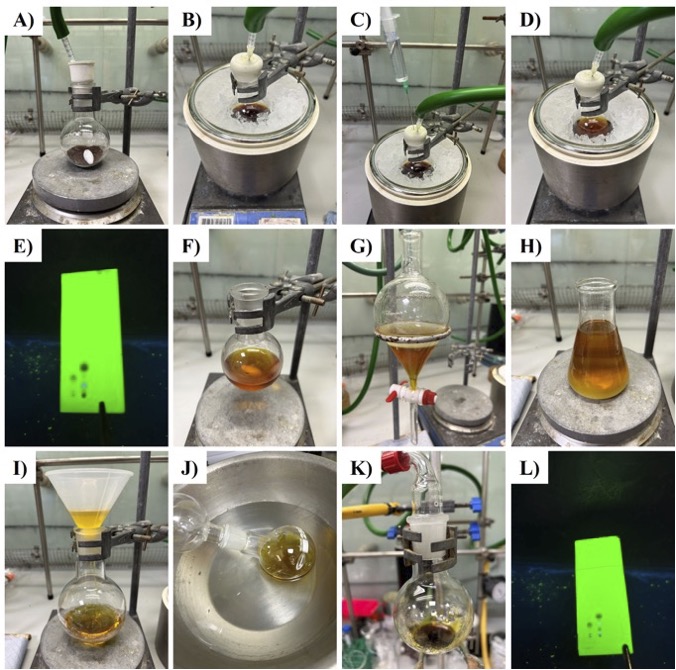
Figure 1. Acylation of
1-iodo-2-naphthol; A. A single-necked flask charged with
1-iodo-2-naphthol and
DMAP; B.
DCM is added and cooled to 0 °C in an ice bath; C.
TEA is added by a syringe; D. Reaction mixture after adding
Ac2O; E. TLC analysis (PE:
EtOAc = 8:1)
of the reaction, Left lane:
1-iodo-2-naphthol, right lane: reaction sample; F. Reaction mixture after completion; G. Extracting the reaction with
DCM and wash with 2N
HCl to remove
TEA, and
DMAP; H. Organic layers are combined and dried over anhydrous
Na2SO4; I. Filtering
Na2SO4 through a plug of cotton; J. Concentrating the filtrate under vacuum using a rotary evaporator; K. Drying the crude product under high vacuum to obtain a brown oil; L. TLC analysis (PE:
EtOAc = 8:1) of the crude brown oil, Left lane :
1-iodo-2-naphthol, right lane: obtained oil.
1. Prior to performing each reaction, a thorough hazard analysis and risk assessment should be carried out with regard to each chemical substance and experimental operation on the scale planned and in the context of the laboratory where the procedures will be carried out. Guidelines for carrying out risk assessments and for analyzing the hazards associated with chemicals can be found in references such as Chapter 4 of "Prudent Practices in the Laboratory" (The National Academies Press, Washington, D.C., 2011; the full text can be accessed free of charge at
https://www.nap.edu/catalog/12654/prudent-practices-in-the-laboratory-handling-and-management-of-chemical. See also "Identifying and Evaluating Hazards in Research Laboratories" (American Chemical Society, 2015) which is available via the associated website "Hazard Assessment in Research Laboratories" at
https://www.acs.org/content/acs/en/about/governance/committees/chemicalsafety/hazard-assessment.html. In the case of this procedure, the risk assessment should include (but not necessarily be limited to) an evaluation of the potential hazards associated with
2-iodo-1-naphthol,
triethylamine,
4-dimethylaminopyridine,
acetic anhydride,
dichloromethane,
NaCl,
Na2SO4,
HCl solution,
phenylacetylene,
Pd(PPh3)2Cl2,
CuI,
hydrazine hydrate,
acetonitrile, silica gel,
petroleum ether,
ethyl acetate,
pentane,
benzyl azide,
[Rh(cod)OH]2, and
1,3,5-trimethoxybenzene.
2. Submitting authors:
1-iodo-2-naphthol was obtained from Fluorochem, Inc. and used as received. TLC analysis showed an impurity. The purity of
1 was determined to be 95.7 wt% by qNMR using
1,3,5-trimethoxybenzene (Sigma-Aldrich, 99%) as the internal standard. Checking authors:
1-Iodo-2-naphthol (97%) was purchased from Oakwood Chemical and used as received. The purity of
1 was determined to be 97.1 wt% by qNMR using
1,3,5-trimethoxybenzene (Sigma-Aldrich, ≥99%) as the internal standard.
3. Submitting authors:
4-Dimethylaminopyridine (
DMAP, 95%) was obtained from Fluorochem, Inc. and used as received. Checking authors:
4-(Dimethylamino)pyridine (purum, ≥98%) was purchased from Sigma Aldrich and used as received.
4.
Dichloromethane (Analytical grade) was obtained from Fisher, and used as received.
5.
Triethylamine (99%) was obtained from Thermo Scientific, and used as received.
6. Submitting authors:
Acetic anhydride (97%) was obtained from Acros Organics, and used as received. Checking authors:
Acetic anhydride (99.5%) was purchased from Sigma Aldrich and used as received.
7. The reaction solution was directly used for TLC monitoring, and reaction progress was determined by TLC analysis on silica gel using 1:8
EtOAc:
petroleum ether as eluent and visualization under 254 nm UV (Rf = 0.30).
8. 2 M
HCl solution was prepared by slowly adding concentrated
HCl (100 mL) to 500 mL water. Care should be taken with exothermic dilution of
HCl. Concentrated
HCl (37 wt%) was obtained from Fisher, and used as received.
9. Gas evolution and pressure build-up observed upon swirling of separatory funnel.
10. Checking authors:
Sodium chloride (Bioreagent, ≥99%) was purchased from Sigma Aldrich.
11. Anhydrous
Na2SO4 (99%) was obtained from Fisher and used as received.
12. The submitting authors gravity filtered the solution through a plug of cotton.
13. The crude TLC analysis was performed on silica gel using 1:8
EtOAc:
petroleum ether as eluent and visualization under 254 nm UV.
14. Submitting authors: A 1 mmol scale reaction was conducted, and the pure (
2) (287 mg, 92% yield) was isolated by silica gel column chromatography, eluting with 1:10
EtOAc:
petroleum ether. Checking authors: A small portion of the crude material was purified using the author's purification procedure to obtain pure (
2) as a yellow viscous oil with 99.8% purity as determined by qNMR
pdf using
1,3,5-trimethoxybenzene (Sigma-Aldrich, ≥99%) as an internal standard.
15.
1-Iodonaphthalen-2-yl acetate (
2): colorless oil;
1H NMR
pdf (400 MHz, CDCl
3) δ 8.17 (dt,
J = 8.4, 1.0 Hz, 1H), 7.85 (d,
J = 8.7 Hz, 1H), 7.81 (dt,
J = 8.1, 0.9 Hz, 1H), 7.60 (ddd,
J = 8.4, 6.9, 1.4 Hz, 1H), 7.51 (ddd,
J = 8.1, 6.8, 1.2 Hz, 1H), 7.23 (d,
J = 8.8 Hz, 1H), 2.45 (s, 3H).;
13C NMR
pdf (126 MHz, CDCl
3) δ 169.0, 150.2, 135.4, 132.3, 132.2, 130.3, 128.5, 128.4, 126.6, 121.5, 94.7, 21.5 ; HRMS (ESI+) calc. for C
12H
9IO
2 [M+H]+ 312.9720, found 312.9721.
16.
Pd(PPh3)2Cl2 (98%) was obtained from Sigma-Aldrich, and used as received.
17.
CuI (99%) was purchased from Sigma-Aldrich, and used as received.
18. The submitting authors used a preheated oil bath.
19.
Phenylacetylene (98%) was obtained from Sigma-Aldrich, and used as received.
20. The reaction solution was directly used for TLC monitoring, and reaction progress was determined by TLC analysis on silica gel using 1:8
EtOAc:
petroleum ether as eluent and visualization under 254 nm UV (Rf = 0.23).
21. Submitting authors:
Ethyl acetate (Analytical Grade) was obtained from Fisher and used as received. Checking authors:
Ethyl acetate (HPLC Grade) was purchased from Sigma Aldrich and used as received.
22. Checking authors: Celite
® S (filter aid, dried, untreated) was obtained from Sigma Aldrich.
23. Submitting authors: A 0.8 mmol scale reaction was conducted to afford pure (
3) (195 mg, 85% yield) after purification by silica gel column chromatography eluting with 1:10
EtOAc/
petroleum ether, followed by trituration with
petroleum ether and filtration. Checking authors: A small portion of the crude material was purified using author's purification procedure to obtain pure (
3) as a light yellow solid with 98.6% purity as determined by qNMR
pdf using
1,3,5-trimethoxybenzene (Sigma-Aldrich, ≥99%) as an internal standard.
24.
1-(Phenylethynyl)naphthalen-2-yl acetate (
3): light yellow solid, .m.p. = 102-104 °C;
1H NMR
pdf (400 MHz, CDCl
3) δ 8.40 (d,
J = 8.3 Hz, 1H), 7.86 (dd,
J = 8.5, 3.3 Hz, 2H), 7.61 (ddd,
J = 7.6, 5.2, 2.1 Hz, 3H), 7.53 (ddd,
J = 8.2, 6.9, 1.3 Hz, 1H), 7.46 - 7.34 (m, 3H), 7.28 (d,
J = 8.9 Hz, 1H), 2.44 (s, 3H);
13C NMR
pdf (126 MHz, CDCl
3) δ 169.2, 150.5, 134.0, 131.8, 131.5, 129.9, 128.8, 128.6, 128.4, 127.5, 126.4, 126.4, 123.3, 121.3, 113.4, 99.6, 82.6, 21.1; HRMS (ESI+) calc. for C
20H
14O
2 [M+H]+ 287.10666, found 287.10665. The compound (
3) is stable on the benchtop at room temperature under air atmosphere.
25. Submitting authors:
Acetonitrile (Analytical Grade) was obtained from Fisher and used as received. Checking authors:
Acetonitrile (HPLC Grade) was purchased from Sigma Aldrich and used as received.
26.
Hydrazine hydrate (
N2H4, 50-60%) was obtained from Sigma-Aldrich and used as received.
27. An aliquot of reaction was diluted with
DCM and used for TLC monitoring. Reaction progress was determined by TLC analysis on silica gel using 1:4
DCM:
petroleum ether as eluent and visualization under 254 nm UV (Rf = 0.30). The Rf of TLC analysis (1:8
EtOAc:
petroleum ether) of compound (
4) was the same as intermediate (
3).
28. Submitting authors: Silica gel (0.040-0.063 mm, 230-400 mesh) was obtained from Sigma-Aldrich and used as received. Checking authors: Silica gel (high-purity grade, 70-230 mesh) was purchased from Sigma Aldrich and used as received.
29. Submitting authors:
Petroleum ether (40-60°C) (Analytical grade) was obtained from Fisher and used as received. Checking authors:
Petroleum Ether (ACS grade) was purchased from Sigma Aldrich and used as received.
30. The fractions were determined by TLC analysis on silica gel using 1:8
EtOAc:
petroleum ether as eluent and visualization under 254 nm UV.
31.
Pentane (99%) was obtained from Fisher and used as received.
32.
1-(Phenylethynyl)naphthalen-2-ol (
4): off white solid, m.p. = 91-92 °C;
1H NMR
pdf (400 MHz, CDCl
3) δ 8.20 (d,
J = 8.3 Hz, 1H), 7.79 (dd,
J = 8.6, 5.1 Hz, 2H), 7.70 - 7.61 (m, 2H), 7.56 (ddd,
J = 8.3, 6.9, 1.3 Hz, 1H), 7.48 - 7.35 (m, 4H), 7.24 (d,
J = 9.0 Hz, 1H), 6.20 (s, 1H).
13C NMR
pdf (101 MHz, CDCl
3) δ 156.1, 133.7, 131.8, 130.9, 129.0, 128.7, 128.6, 128.5, 127.6, 125.0, 124.3, 122.8, 116.5, 103.0, 101.4, 81.7; HRMS (ESI+) calc. for C
18H
12O [M+H]+ 245.0961, found 245.0961. The product (4) is stable on the benchtop at room temperature under air atmosphere.
33. The purity of (
4) was determined to be 98.4 wt% for Run 1 and 99.3 wt% for Run 2 by qNMR
pdf using
1,3,5-trimethoxybenzene (Sigma-Aldrich, ≥99%) as the internal standard.
34. The solid was evaluated by TLC analysis on silica gel using 1:8
EtOAc:
petroleum ether as eluent and visualization under 254 nm UV (Rf = 0.24).
35. The filtrate could be further purified by silica gel column chromatography, if desired.
36.
Hydroxy(cyclooctadiene)rhodium(I) dimer (95%) was obtained from Sigma-Aldrich and used as received. This catalyst should be a light-yellow powder. The submitting authors note that this chemical from some other suppliers is an orange solid, which did not perform well in this reaction.
37. Submitting authors:
(S)-(+)-N-(3,5-dioxa-4-phosphacyclohepta[2,1-a;3,4-a']dinaphthalen-4-yl)-dibenzo[b,f]azepine (97%, 99% ee) was obtained from Bide Pharmatech Ltd, and used as received. The compound was not totally stable, changing color from white to yellow powder over a few days at ambient temperature. The purity of this ligand should be checked before use by simple TLC analysis or NMR. Checking authors:
(S)-(+)-N-(3,5-dioxa-4-phosphacyclohepta[2,1-a;3,4-a']dinaphthalen-4-yl)-dibenzo[b,f]azepine (98%, 99% ee) was purchased from Ambeed and used as received.
38. Submitting authors:
Benzyl azide (practical grade) was obtained from Fluorochem, Inc. and used after flushing the compound through a short column of silica gel with
petroleum ether. Checking authors:
Benzyl azide solution (~0.5 M in
dichloromethane, ≥ 95%) was purchased from Sigma-Aldrich and used as received.
39. The submitting authors noted that without the additional purification of
benzyl azide, the reaction provided compound
5 with reduced ee (78%).
40. The submitting authors previously carried out the reaction on a 10 mmol scale using freshly synthesized
benzyl azide, and the reaction was completed within 3 h.
41. The four chemicals should be mixed together as soon as possible. Mixing the
[Rh(cod)OH]2 and ligand first, for 15 min, followed by the alkyne and azide gave a lower 85% ee.
42. Precipitate formation is observed if some solvent evaporation occurs. Without solvent loss, the reaction mixture remained clear. This has no noticeable impact on reaction outcome.
43. The reaction was evaluated by TLC analysis on silica gel using 1:2
EtOAc:
petroleum ether as eluent and visualization under 254 nm UV (Rf = 0.19).
44.
(S)-1-(1-Benzyl-4-phenyl-1H-1,2,3-triazol-5-yl)naphthalen-2-ol (
5): off white solid, m.p. = 213-215 °C for Run 1 and 209-210 °C for Run 2; >99% ee, [α]
D20 = +72.1 for Run 1 and +71.6 for Run 2 (c = 1.0, DMSO); [α]
D20 = +24.6 for Run 1 and +27.2 for Run 2 (c = 0.5, CHCl
3).
1H NMR
pdf (400 MHz, DMSO-
d6) δ: 10.38 (s, 1H), 8.01 (d,
J = 9.0 Hz, 1H), 7.86 (d,
J = 8.0 Hz, 1H), 7.47 - 7.40 (m, 2H), 7.35 (d,
J = 9.0 Hz, 1H), 7.26 (t,
J = 7.4 Hz, 1H), 7.21 - 7.08 (m, 7H), 6.92 - 6.85 (m, 2H), 6.79 (d,
J = 8.3 Hz, 1H), 5.28 (d,
J = 15.2 Hz, 1H), 5.18 (d,
J = 15.2 Hz, 1H) ;
13C NMR
pdf (126 MHz, DMSO-
d6) δ: 154.5, 144.2, 135.2, 132.7, 132.1, 131.3, 129.0, 128.5, 128.4, 128.2, 127.7, 127.7, 127.6, 127.5, 127.4, 125.2, 123.2, 122.5, 118.1, 105.7, 51.3.; HRMS (ESI+) calc. for C
25H
19N
3O [M+H]+ 378.16009, found 378.16006. The product (
5) is stable on the benchtop at room temperature under air atmosphere.
45. The purity of the title compound (
5) was determined to be 99.2 wt% for both Run 1 and Run 2 by qNMR
pdf using
1,3,5-trimethoxybenzene (Sigma-Aldrich, ≥99%) as the internal standard.
46. Compound
5 was shown to have >99% ee for both Run 1 and Run 2. Racemic
5 was prepared by an identical procedure without including the chiral ligand. Chiral HPLC
pdf, Column: Chiralpak IC-3 (0.3 cm x 10 cm), Mobile phase:
n-hexane/
2-propanol = 60/40, flow rate = 1.0 mL/min, wavelength = 254 nm, column temperature = 30°C, t (major) = 2.5 min, t (minor) = 2.1 min. The reaction mixture of
5 showed a 94% ee.
47. The filtrate showed 70% ee for Run 1 and 72% ee for Run 2. Chiral HPLC, Column: Chiralpak IC-3 (0.3 cm x 10 cm), Mobile phase:
n-hexane/
2-propanol = 60/40, flow rate = 1.0 mL/min, wavelength = 254 nm, column temperature = 30°C, t (major) = 2.5 min, t (minor) = 2.1 min.
48. The solid and filtrate were evaluated by TLC analysis on silica gel using 1:2
EtOAc:
petroleum ether as eluent and visualization under 254 nm UV (Rf = 0.19).
3. Discussion
These works have paved the way for click chemistry in axial chirality, and hold great promise for broad applications across atroposelective synthesis, medicinal chemistry, and chemical biology.
Copyright © 1921-, Organic Syntheses, Inc. All Rights Reserved