Org. Synth. 2026, 103, 192-204
DOI: 10.15227/orgsyn.103.0192
Copper-Mediated Oxidative Bromodifluoromethylation of Phenols: Preparation of Phenyl 4-(bromodifluoro-methoxy)benzoate
Submitting Authors: Wen-Juan Yuan, Chao-Lai Tong, and Feng-Ling Qing*
1Checking Authors: Uroš Vezonik, Sabela Vega-Ces, and Nuno Maulide*
21. Procedure (Note 1)
Phenyl 4-(bromodifluoromethoxy)benzoate (2). A 250-mL, three-necked, round-bottomed flask equipped with a Teflon-coated egg-shaped magnetic stir bar (43 mm x 14 mm), a septum, an internal thermometer and a balloon equipped with a T-bore stopcock, was charged with Selectfluor (10.63 g, 30 mmol, 2.0 equiv) (Note 2) and CuBr (10.76 g, 75 mmol, 5.0 equiv) (Note 3). The remaining neck was sealed with a rubber septum, and the flask was evacuated and backfilled with nitrogen in triplicate (Figure 1A). After placing the mixture in an ice bath, anhydrous N-methyl-2-pyrrolidone (75 mL) (Note 4) was added via a disposable 40 mL plastic syringe with a stainless steel needle (0.8 x 120 mm, G21 fitting) (Figure 1B). Then the reaction mixture was stirred (500 rpm) in an ice bath for 5 min. This step was exothermic, which caused a rapid increase of internal temperature, reaching up to 38 °C, and then gradually decreased. The septum was removed and the flask was charged with phenyl 4-hydroxybenzoate (3.21 g, 15 mmol, 1.0 equiv) in one portion (Note 5). After recapping and stirring the solution for another 5 min in an ice bath, (bromodifluoromethyl)trimethylsilane (9.14 g, 45 mmol, 3.0 equiv) (Note 6) was added using a disposable 10 mL plastic syringe with a stainless steel needle (0.8 x 120 mm, G21 fitting). This step was exothermic slightly and produced a small amount of gas, causing the balloon to bulge (Figure 1C). The reaction mixture was stirred for 5 min in an ice bath and finally stirred at room temperature (23 °C) for 12 h. The completion of the reaction was checked by 19F NMR (Note 7).
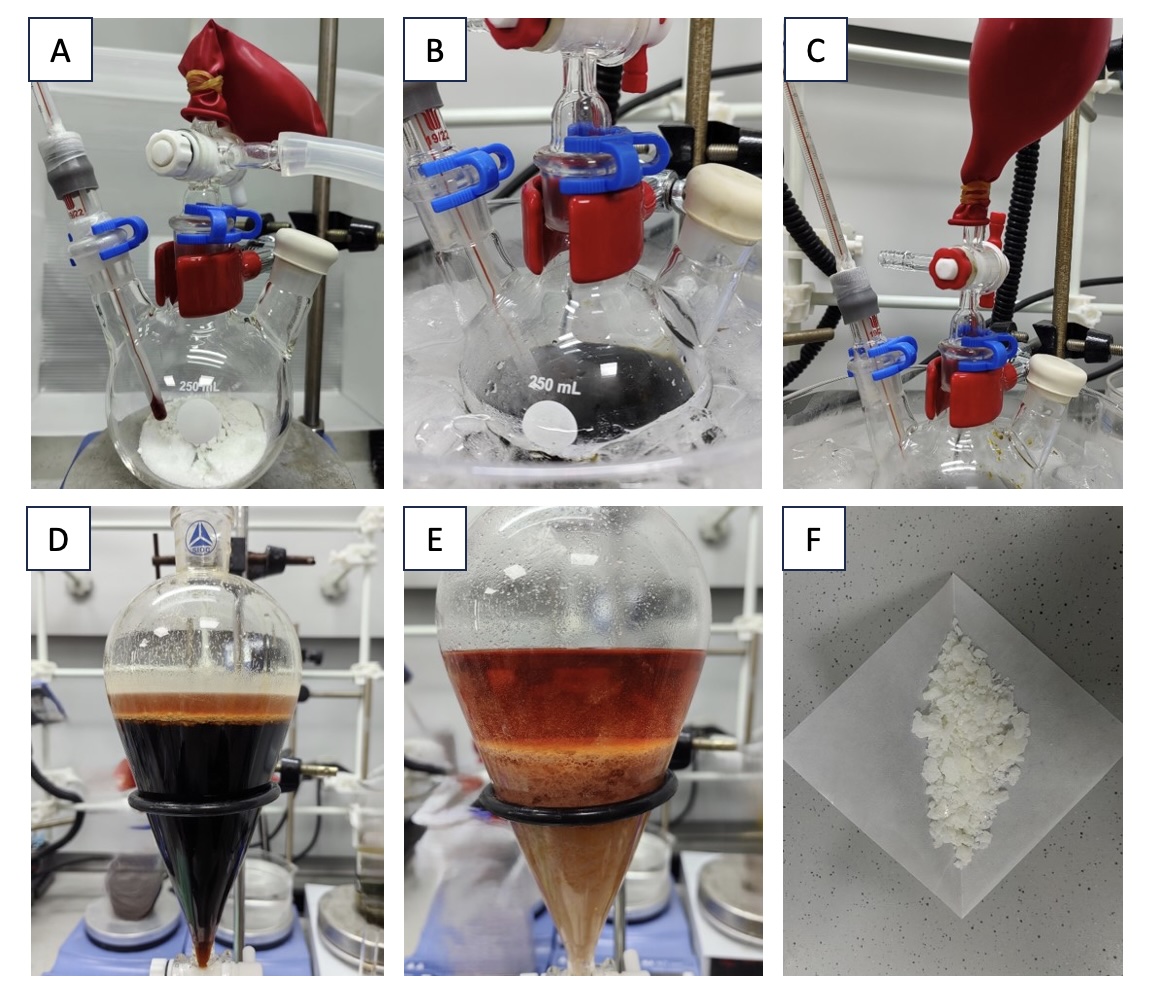
Figure 1. A. Reaction set-up; B. Reaction mixture after the addition of solvent; C. Generation of gas after the addition of TMSCF2Br; D. Extraction; E. Pooled organic layers washed with brine; F. Pure product. (Photos provided by the submitting authors)
The reaction mixture was diluted with saturated ammonium chloride solution (150 mL) (Note 8) and transferred to a 250-mL separatory funnel, and the aqueous phase was separated and extracted with three 50-mL portions of diethyl ether (Figure 1D). The pooled organic layers were washed with brine (150 mL) (Figure 1E) (Note 9), and then dried over 7 g of anhydrous sodium sulfate for 5 min. After drying, the organic layer was filtered through cotton contained in a glass funnel into a 500 mL round-bottom flask and concentrated on a rotary evaporator (40 °C, 100 mbar, 15 min, followed by 15 mbar for 30 min) to afford 5.9 g of a yellow oil which was analyzed by TLC (Note 10). To the oil was added silica gel (4.0 g) and the resulting paste was charged onto a column (64 x 500 mm) of 120 g of silica gel topped with a layer of sand (0.5 cm) using heptane (Notes 11 and 12). After topping with additional sand (1 cm layer), the column was eluted with 500 mL of heptane. At that point, fraction collection (18-mL fractions) begun, and elution was continued with 550 mL of 1% EtOAc-heptane and then 1200 mL of 2% EtOAc-heptane (Note 13). The desired product was obtained in fractions 62-80 (Note 14), which were concentrated by rotary evaporation (40 °C, 100 mbar, 15 min, then by 15 mbar for 30 min, followed by 2.5x 10⁻² mbar for 1 h) to afford 2 as a colorless powder (3.38 g, 66%) (Figure 1F) (Notes 15,16,17).
2. Notes
1. Prior to performing each reaction, a thorough hazard analysis and risk assessment should be carried out with regard to each chemical substance and experimental operation on the scale planned and in the context of the laboratory where the procedures will be carried out. Guidelines for carrying out risk assessments and for analyzing the hazards associated with chemicals can be found in references such as Chapter 4 of "Prudent Practices in the Laboratory" (The National Academies Press, Washington, D.C., 2011; the full text can be accessed free of charge at
https://www.nap.edu/catalog/12654/prudent-practices-in-the-laboratory-handling-and-management-of-chemical. See also "Identifying and Evaluating Hazards in Research Laboratories" (American Chemical Society, 2015) which is available via the associated website "Hazard Assessment in Research Laboratories" at
https://www.acs.org/about/governance/committees/chemical-safety.html. In the case of this procedure, the risk assessment should include (but not necessarily be limited to) an evaluation of the potential hazards associated with
phenyl 4-hydroxybenzoate,
selectfluor,
CuBr,
N-methyl-2-pyrrolidone,
DCM,
ammonium chloride solution,
(bromodifluoromethyl)trimethylsilane,
heptane,
EtOAc,
diethyl ether,
sodium sulfate, silica gel, and
deuterated chloroform.
2. The checking authors purchased
Selectfluor (98%) from Fluorochem and used it as received. The submitting authors purchased
Selectfluor (>95%) from TCI and used it as received.
3.
CuBr (>98%) was purchased from TCI and used as received.
CuBr was stored in a glovebox because it was sensitive to water and air.
4. The checking authors purchased
N-methyl-2-pyrrolidone (99.5%, extra dry) from ThermoFisher and used it as received. The submitting authors purchased
N-methyl-2-pyrrolidone (99.5%, Superdry, water ≤ 50 ppm) from J&K Scientific and used it as received.
5. The checking authors purchased
phenyl 4-hydroxybenzoate (98%) from Fluorochem and used it as received. The submitting authors purchased
phenyl 4-hydroxybenzoate (>99%) from TCI and used it as received.
6. The checking authors purchased
(bromodifluoromethyl)trimethylsilane (98%) from Fluorochem and used it as received. The submitting authors purchased
(bromodifluoromethyl)trimethylsilane (>98%) from TCI and used it as received. The material was taken up into a syringe and weighed before addition.
7. The progress of the reaction was monitored by
19F NMR. The internal standard benzotrifluoride (1.10 g, 7.5 mmol; 98%, purchased from TCI and used as received) was added to the reaction mixture and the solution was then analyzed directly by
19F NMR(Figure 2).
Figure 2.19F NMR spectrum of the reaction mixture
8.
Ammonium chloride (>95% purity) was purchased from Carlo Erba.
9. TLC analysis of the water phase was needed. The aqueous phase was extracted with another 50-mL portions of
diethyl ether (>99.8% purity, ThermoFisher) until there was no product in it.
10. The submitting authors found the product
2 to have an R
f of 0.66, as analyzed by TLC on silica. The TLC plate was eluted with 50:1
petroleum ether:
EtOAc and visualized using 254 nm UV light (Figure 7).
Figure 3. TLC analysis (photo provided by submitting authors)
11.
Heptane was purchased from Donauchemie. The submitting authors report using
petroleum ether.
12. The yellow oil was mixed with 4.0 g silica gel to form a paste-like mixture. This was diluted with
heptane (3-5 mL) and the resulting suspension was transferred to the column using a Pasteur pipette. Additional
heptane (3 mL) was used to wash the flask and transfer any residual material.
13.
Ethyl acetate was purchased from Donauchemie.
14. Fractions containing the product were identified by TLC analysis (50:1
heptane:
EtOAc as eluent). Fractions 62-80 contained the desired product that was visualized by UV irradiation (Figure 4). Test tubes of 62-80 were each rinsed with
EtOAc (3 x 1 mL), and the rinses were transferred into the collection flask.
Figure 4. TLC analysis of column fractions(picture provided by checking authors)
15. A second run on half scale provided 1.57 g (61%) of
2. The submitting authors reported a full-scale run to yield 3.20 g (62%).
16. Compound
2 has the following characteristics:
1H NMR pdf (400 MHz, CDCl
3) δ 8.29 (d,
J = 8.9 Hz, 2H), 7.50 - 7.40 (m, 2H), 7.39 (dq,
J = 7.8, 1.0 Hz, 2H), 7.30 (dt,
J = 7.4, 2.1 Hz, 1H), 7.25 - 7.20 (m, 2H).
13C NMR pdf (101 MHz, CDCl
3) δ 164.2, 154.6 (t,
J = 1.9 Hz), 150.9, 132.3, 129.7, 128.3, 126.2, 121.7, 121.2, 114.0 (t,
J = 310.3 Hz).
19F NMR pdf (376 MHz, CDCl
3) δ -15.92 (s, 2F).
IR (ATR):
νmax 3069, 1737, 1591, 1485, 1412, 1265, 1135, 1072, 1000, 874, 751, 628 cm
-1.
HRMS (
ESI): m/z M+Na
+ Calcd for C
14H
9BrF
2O
3Na: 364.9595; Found: 364.9600. m.p. 38.8-39.9 °C.
17. The purity of product
2 was determined using
1H qNMR analysis.
1H NMR was performed using a mixture of
2 (25.3 mg) and dimethyl fumarate (10.2 mg) (TCI, >98%, as an internal standard) in CDCl
3. The purity was calculated according to standard method as 98.9 wt%. The half-scale run provided product 2 with 100.5% purity (as determined by qNMR). The submitting authors reported 100.1% purity by qNMR
pdf and additional elemental analysis: Calcd for C
14H
9BrF
2O
3: C 49.01; H 2.64. Found: C, 49.05; H, 2.87 (1st run, 2.395 mg), C, 48.96; H, 2.80 (2nd run, 2.402 mg).
Working with Hazardous Chemicals
The procedures in
Organic Syntheses are intended for use only by persons with proper training in experimental organic chemistry. All hazardous materials should be handled using the standard procedures for work with chemicals described in references such as "Prudent Practices in the Laboratory" (The National Academies Press, Washington, D.C., 2011; the full text can be accessed free of charge at
http://www.nap.edu/catalog.php?record_id=12654). All chemical waste should be disposed of in accordance with local regulations. For general guidelines for the management of chemical waste, see Chapter 8 of Prudent Practices.
In some articles in Organic Syntheses, chemical-specific hazards are highlighted in red "Caution Notes" within a procedure. It is important to recognize that the absence of a caution note does not imply that no significant hazards are associated with the chemicals involved in that procedure. Prior to performing a reaction, a thorough risk assessment should be carried out that includes a review of the potential hazards associated with each chemical and experimental operation on the scale that is planned for the procedure. Guidelines for carrying out a risk assessment and for analyzing the hazards associated with chemicals can be found in Chapter 4 of Prudent Practices.
The procedures described in Organic Syntheses are provided as published and are conducted at one's own risk. Organic Syntheses, Inc., its Editors, and its Board of Directors do not warrant or guarantee the safety of individuals using these procedures and hereby disclaim any liability for any injuries or damages claimed to have resulted from or related in any way to the procedures herein.
3. Discussion
Fluoroalkyl ethers are valuable structural motifs in the area of pharmaceutical and agrochemical discovery, because the introduction of fluoroalkoxy group resulted in the increased lipophilicity and metabolic stability over their nonfluorinated analogues.
3 While tremendous effort has been directed to trifluoromethyl ethers,
4 the analogous difluoroalkyl ethers have attached less attention in spite of their importance in medicinal chemistry. In particular, chlorodifluoromethyl
5 and bromodifluoromethyl
6 aryl ethers are increasingly found in biologically active compounds, because of their strong halogen bond interactions and their unconventional interaction geometries.
7 In addition, chloro- and bromodifluoromethyl aryl ethers can be used to prepare a range of fluorine-containing compounds.
8 Despite the importance of chlorodifluoromethyl and bromodifluoromethyl aryl ethers, synthetic approaches to these compounds are limited.
Chlorodifluoromethyl aryl ethers are usually prepared by photochlorination of difluoromethyl aryl ethers
9 or nucleophilic fluorination of trichloromethyl aryl ethers
10 and aryl chlorothioformates.
11 Yet implementing these methods in the lab is very challenging due to the harsh reaction conditions. The bromodifluoromethylation of phenolate salts with CF
2Br
2 is a widely used method to make bromodifluoromethyl aryl ethers.
12 Howerer, the yields of the desired products are low due to the poor chemoselectivity, which greatly increasing the difficulty of purification. Additionally, CF
2Br
2 is an ozone-depleting substrate (ODS). Later, Gouverneur developed the dcarboxylative bromination of aryloxydifluoroacetic acids to synthese bomodifluoromethyl aryl ethers, but this method also suffers from tedious preparations and low yields.
8a To close this gap, we recently reported a general method for oxidative chloro- and bromodifluoromethylation of phenols with (CH
3)
3SiCF
2X and CuX (X = Cl, Br) in the presence of selectfluor under mild reaction conditions.
13 This protocol provided a practical and efficient method for synthesis of a diverse range of biologically valuable and synthetically challenging chloro- and bromodifluoromethyl aryl ethers. Preliminary mechanistic studies suggest that this reaction proceeded through a difluorocarbene-involved oxidative coupling process.
In summary, we have developed a direct and general synthesis of chloro- and bromodifluoromethyl aryl ethers through the copper-mediated difluorocarbene-involved oxidative chloro- and bromodifluoromethylation of phenols. This protocol provides facile access to chloro- and bromodifluoromethyl aryl ethers from commercially available phenols, a difluorocarbene source, and CuX (X = Cl, Br). Its operational simplicity, mild reaction conditions, simple starting materials and excellent chemoselectivity render it an attractive alternative protocol to traditional methods for the preparation of chloro- and bromodifluoromethyl aryl ethers. We are optimistic that these new reactions will find use in medicinal and material chemistry.
Appendix
Chemical Abstracts Nomenclature (Registry Number)
Phenyl 4-hydroxybenzoate: phenyl 4-hydroxybenzoate; (17696-62-7)
Selectfluor: 1-chloromethyl-4-fluoro-1,4-diazoniabicyclo[2.2.2]octane bis(tetrafluoroborate); (140681-55-6)
(Bromodifluoromethyl)trimethylsilane: (bromodifluoromethyl)trimethylsilane; (115262-01-6)
CuBr: copper(I) bromide; (7787-70-4)

|
Wen-Juan Yuan received her B. S. degree in pharmacy from Zhengzhou University in 2020. She is currently a fourth-year graduate student at Shanghai Institute of Organic Chemistry, Chinese Academy of Sciences under the supervision of Prof. Feng-Ling Qing. Her research interests focus on the synthesis of fluoroalkyl ethers. |

|
Chao-Lai Tong received his B. S. degree in Chemical Engineering and Process from Zhejiang University of Technology in 2017. He became a graduate student at Shanghai Institute of Organic Chemistry, Chinese Academy of Sciences under the supervision of Prof. Feng-Ling Qing and he received his Ph. D. degree in 2022. His research interests focused on the development of heptafluoroisopropylation, heptafluoroisopro-poxylation and heptafluoroisopropylthiolation reactions. At present he is working in the Pharmaron in Zhejiang Province. |

|
Feng-Ling Qing received his Ph.D. in 1990 from Shanghai Institute of Organic Chemistry (SIOC), Chinese Academy of Sciences. In 1997, he was promoted to Professor at SIOC. His research focuses on organofluorine chemistry and fluorinated materials. |

|
Uroš Vezonik obtained an MSc in Chemistry from the University of Ljubljana, where he conducted research under the supervision of Prof. Janez Košmrlj. During his master's studies, he completed a research visit with Prof. David Šarlah, focusing on the total syntheses of marine triterpenoids. Since 2022, he has been a PhD student in the group of Prof. Nuno Maulide, where he is developing novel synthetic methodologies based on highly reactive electrophilic species, with applications in the synthesis of natural products and pharmaceutically relevant compounds. |

|
Sabela Vega-Ces obtained a MSc in Chemistry-Molecular Sciences from the UvA and VU in Amsterdam. She conducted her Master Thesis under the supervision of Prof. 't Hart at the CGC of Max Planck Society in Dortmund, working on macrocyclic peptides. She took part in Hoffmann-La Roche Medicinal Chemistry Internship program (RiCH) in Basel contributing to the Pharma Research and Early Development (pRED) department. She is currently a third-year PhD student in the group of Prof. Maulide, working on synthetic methodology based on the in situ generation of high-energy reactive intermediates under mild conditions to access unconventional reactivity. |

|
Nuno Maulide obtained his Ph.D. at the Université catholique de Louvain under the supervision of Prof. István E. Markó in 2007, followed by a postdoctoral stay in the group of Prof. Barry M. Trost at Stanford University. In 2009, he started his independent career at the Max-Planck Institut für Kohlenforschung. Following this, in 2013, he became a Full Professor at the University of Vienna. His research interests are broadly spread in the field of organic chemistry and include method development, total synthesis and medicinal chemistry-driven investigations. |
Copyright © 1921-, Organic Syntheses, Inc. All Rights Reserved