Org. Synth. 2026, 103, 205-217
DOI: 10.15227/orgsyn.103.0205
Preparation of 2-Iodoxybenzoic Acid (IBX)
Submitting Authors: Marianna C. Tonoyan, Aimee K. Long, and Neil K. Garg*
1Checking Authors: Milos Vavrik, Nikolaos Skoulikas, and Nuno Maulide
21. Procedure (Note 1)
A. 2-Iodoxybenzoic acid (IBX) (2). A single-necked (24/40 joint) 500-mL round-bottomed flask is charged with a Teflon-coated magnetic stir bar (1.5 x 2.5 cm, oval) and deionized water (200 mL). To the unsealed flask, Oxone (37 g, 60 mmol, 3 equiv) (Notes 2 and 3) is added in a single portion at 23 °C (Note 4). Stirring is started (650 rpm), and the solution is stirred for 5 min to give a homogeneous solution (Figure 1A). The stir rate is increased to 750 rpm, then freshly ground 2-iodobenzoic acid (1) (5.0 g, 20 mmol, 1.0 equiv) (Notes 5 and 6) is added in a single portion. The flask is then fitted with a Vigreux distilling column (2.5 cm OD x 38 cm tall, 24/40 upper joint, 24/40 lower joint) and left open to air. The joint between the reaction flask and the column is wrapped tightly with Teflon tape and clamped with a green 24/40 Keck clip. The apparatus is then placed in a water bath preheated to 70 °C (Note 7) and stirred at 1500 rpm, resulting in a vortex, for 2 h (Figure 1B) (Notes 8 and 9). Immediately after placing the vessel into the water bath, a blast shield is placed in front of the reaction vessel.
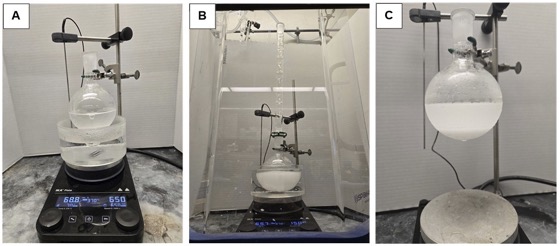
Figure 1. A. Oxone solution after stirring with water; B. Reaction assembly with air condenser; C. Reaction vessel after cooling
After 2 h, the reaction flask is then transferred directly from the 70 °C water bath to an ice bath cooled to 0 °C. The blast shield is removed, and the solution is stirred at 1500 rpm at 0 °C for an additional 30 min. Upon cooling, a white solid precipitates out of solution and collects at the bottom of the flask (Note 10, Figure 1C). The vessel is removed from the ice bath and allowed to warm to 23 °C over the course of 30 min. The stir bar is removed with a magnetic stir bar retriever while rinsing with deionized water (5 mL). The resulting heterogeneous solution is then vacuum filtered through a 150 mL medium-porosity Büchner funnel or sintered glass filter (porosity 4), into a 1000-mL single-necked round-bottomed flask (24/40 joint) (Note 11). The filtered residue is rinsed six times with deionized water (6 × 20 mL), twice with methanol (2 × 20 mL), then twice with acetone (2 × 20 mL) (Figure 2) (Notes 12,13,14).
Figure 2. Filtration apparatus
The resulting white solid is then transferred to a 4-dram vial, which is placed into a 250 mL round-bottom flask. The flask is connected to a vacuum pump and the material is dried under high vacuum (<1.0 mmHg, Note 15) for 1 h at 23 °C to afford IBX (2) as a colorless powder (3.84 g, 69% yield) (Figure 3) (Notes 16,17,18,19,20).
Figure 3. Isolated IBX (2)
2. Notes
1. Prior to performing each reaction, a thorough hazard analysis and risk assessment should be carried out with regard to each chemical substance and experimental operation on the scale planned and in the context of the laboratory where the procedures will be carried out. Guidelines for carrying out risk assessments and for analyzing the hazards associated with chemicals can be found in references such as Chapter 4 of "Prudent Practices in the Laboratory" (The National Academies Press, Washington, D.C., 2011; the full text can be accessed free of charge at
https://www.nap.edu/catalog/12654/prudent-practices-in-the-laboratory-handling-and-management-of-chemical. See also "Identifying and Evaluating Hazards in Research Laboratories" (American Chemical Society, 2015) which is available via the associated website "Hazard Assessment in Research Laboratories" at
https://www.acs.org/about/governance/committees/chemical-safety.html. In the case of this procedure, the risk assessment should include (but not necessarily be limited to) an evaluation of the potential hazards associated with
2-iodobenzoic acid (
1),
Oxone,
acetone,
methanol, and
IBX (
2). Caution:
IBX is a heat- and shock-sensitive compound, showing exothermic behavior at temperatures exceeding 130 °C. All operations should be conducted behind an explosion shield.
IBX should not transferred with a metal spatula or ground in a mortar and pestle due to the shock-sensitivity of this compound. Although no problems were encountered with the explosion of
IBX or other chemicals in the use of this oxidation procedure, prudence dictates that all operations should be conducted in a hood.
2.
Oxone (
2KHSO5·KHSO4·K2SO4) was purchased from Sigma-Aldrich and used as received.
3. Using a larger excess of
Oxone is crucial to allow for high purity of
IBX (
2). Using a smaller excess of
Oxone (1.5 equiv) results in the isolation of
1-hydroxy-1,2-benziodoxol-3(1H)-one.
4. The flask can be placed directly above the preheated (70 °C) water bath used later, but the checking authors found that this is optional and dissolution of
Oxone also occurs readily in the absence of this heating source.
5. The submitting authors purchased
2-iodobenzoic acid (
1) (99%) from Oakwood Product Inc. The checking authors purchased
1 (98%) from Sigma-Aldrich. Both were used as received.
6. The
2-iodobenzoic acid (
1) was ground into a fine powder via mortar (11 cm OD x 7 cm tall) and pestle (3 cm OD) (Figure 4) prior to use. Any large chunks remaining may impact the stirring, resulting in lower yields and additional impurities.
Figure 4. Freshly ground 2-iodobenzoic acid (1)
7. A preheated water bath is used to prevent overheating of the reaction due to safety concerns of the thermal sensitivity of
IBX (
2). The water bath is refilled as needed throughout the reaction.
8. The stir rate was adjusted periodically throughout the duration of the reaction in order to maintain a vortex. The precise stir rate is inconsequential, as long as the reaction mixture is vigorously stirring resulting in a vortex for the entire duration of the reaction.
9. The progress of the reaction can be monitored by
1H NMR spectroscopic analysis. To obtain a sample for
1H NMR analysis, the air condenser is briefly removed, and a drop of the reaction mixture is removed by a 9-inch Pasteur pipette and then added into a 1-dram vial containing 0.5 mL of DMSO-
d6. It is important to take the sample while stirring, so as to avoid settling of the solids before taking the sample.
10. The checking authors observed some solid forming already at 70 °C.
11. Deionized water (20 mL) was used to rinse the reaction flask to ensure quantitative transfer.
12.
Acetone (99.5%) was purchased from Fisher Scientific and used as received.
13.
Methanol (99%) was purchased from Fisher Scientific and used as received.
14. Caution! The
acetone wash solution must not be combined with the previous filtrates, so as not to mix
acetone with residual
Oxone.
15. A Kimwipe was placed over the vial while under high vacuum to prevent loss of material.
16. The vial containing
IBX was covered with aluminum foil to protect it from light and stored in a freezer compatible with oxidants (-20 °C).
17. The checking authors performed two runs. The full-scale reaction gave 3.84 g (69% yield) of product. The half-scale reaction gave 1.79 g (64% yield). The purities of both batches were determined to be >97% by qNMR
pdf using 1,3,5-trimethoxybenzene (TCI, 98%) as the internal standard. The submitting authors report yields of 70-71% obtained across two runs. The purity of product
2 obtained was determined to be 97.2-99.6% by qNMR using 1,3,5-trimethoxybenzene (Alfa Aesar, 99%) as the internal standard.
18. Of note, dissolution of
2 in DMSO is not instantaneous and was found to take up to 10 min at 23 °C.
19. Using dry deuterated solvent revealed the ring-opened tautomer of
IBX. To the qNMR sample was added 20 μL of deionized water to shift the equilibrium toward the ring-closed tautomer
2, as depicted in Figure 5.
20. Product
2 was characterized as follows:
1H NMR
pdf (600 MHz, DMSO-
d6) δ: 8.17 - 8.12 (m, 1H), 8.03 (dd,
J = 7.5, 1.4 Hz, 1H), 8.00 (td,
J = 7.6, 1.4 Hz, 1H), 7.84 (td,
J = 7.3, 1.0 Hz, 1H);
13C NMR
pdf (151 MHz, DMSO-
d6) δ: 167.6, 146.6, 133.5, 133.0, 131.5, 130.2, 125.0; IR
pdf (ATR): 3073, 1636, 1455, 1437, 1332, 1298, 1248, 1141, 832, 779 cm
-1; HRMS (ESI): [M-H]
- calcd for C
7H
4IO
4: 278.9160, found: 278.9148.
Working with Hazardous Chemicals
The procedures in
Organic Syntheses are intended for use only by persons with proper training in experimental organic chemistry. All hazardous materials should be handled using the standard procedures for work with chemicals described in references such as "Prudent Practices in the Laboratory" (The National Academies Press, Washington, D.C., 2011; the full text can be accessed free of charge at
http://www.nap.edu/catalog.php?record_id=12654). All chemical waste should be disposed of in accordance with local regulations. For general guidelines for the management of chemical waste, see Chapter 8 of Prudent Practices.
In some articles in Organic Syntheses, chemical-specific hazards are highlighted in red "Caution Notes" within a procedure. It is important to recognize that the absence of a caution note does not imply that no significant hazards are associated with the chemicals involved in that procedure. Prior to performing a reaction, a thorough risk assessment should be carried out that includes a review of the potential hazards associated with each chemical and experimental operation on the scale that is planned for the procedure. Guidelines for carrying out a risk assessment and for analyzing the hazards associated with chemicals can be found in Chapter 4 of Prudent Practices.
The procedures described in Organic Syntheses are provided as published and are conducted at one's own risk. Organic Syntheses, Inc., its Editors, and its Board of Directors do not warrant or guarantee the safety of individuals using these procedures and hereby disclaim any liability for any injuries or damages claimed to have resulted from or related in any way to the procedures herein.
3. Discussion
This procedure describes an operationally simple method to synthesize 2-iodoxybenzoic acid (IBX,
2, Figure 5), a hypervalent iodide reagent and versatile oxidant in organic synthesis. IBX (
2) was first utilized in organic synthesis to oxidize alcohols to their respective aldehydes and ketones in a 1994 report by Santagostino.
3 Since then, there have been >1500 applications for IBX (
2) as an oxidant, with many reviews available that highlight the versatility of this reagent.
4,5,6Figure 5: Structure of IBX (2)
Several IBX-mediated transformations are shown in Figure 6. IBX (
2) can be utilized for the oxidation of secondary alcohols to the corresponding ketones, as exemplified by the oxidation of menthol (
3) to menthone (
4) (Figure 6A).
7 Additionally, oxidations at the benzylic position are also possible, shown by the transformation of 2-methylnaphthalene (
5) to 2-naphthaldehyde (
6).
8 Reaction conditions are sufficiently mild such that a variety of functional groups can be tolerated that may not be compatible with other oxidants. This renders IBX (
2) an attractive oxidant in total synthesis. One impressive example was seen in Stark's synthesis of (-)-aspidospermidine, wherein silyl enol ether
7 was oxidized to enone
8 (Figure 6B).
9Figure 6. A. Select examples of IBX-promoted oxidations; B. An example of IBX (2) used in total synthesis
IBX (
2) is typically synthesized in either of two ways, described in Figure 7. A previous
Org. Synth. report by Boeckman and co-workers
10 utilized Greenbaum's method
11 to synthesize IBX (
2). This approach involves treatment of 2-iodobenzoic acid (
1) with potassium bromate in sulfuric acid (Figure 7A). Although this procedure is effective in generating IBX (
2) in high yields, there are significant hazards associated, such as the use of a strong acid as the solvent, as well as the evolution of bromine vapor during the reaction. As an alternative, Santagostino and co-workers developed the synthesis of IBX (
2) utilizing Oxone (2KHSO
5·KHSO
4·K
2SO
4) as the oxidant and water as the solvent in 1999 (Figure 7B).
12 This procedure is simple to conduct and reduces the risks associated with synthesizing IBX (
2), while maintaining good yields and excellent purity.
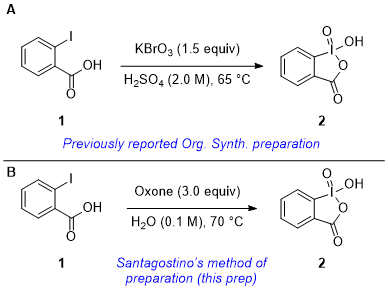
Figure 7. A. Previously reported procedure to synthesize IBX (2) by Boeckman using Greenbaum's method; B. Santagostino's method of preparing IBX (2) using Oxone described herein
Despite the widespread use of IBX (
2) as a reagent, safety is a primary consideration when synthesizing and handling this compound. Several studies have described the dangers associated with IBX (
2), including its shock sensitivity, self-accelerated decomposition, and thermal instability.
13,14 Most recently, our laboratory and colleagues at the Department of Process Research and Development at Merck performed additional studies to assess the safety profile of
2.
15 To determine the shock sensitivity of IBX (
2), testing was conducted using a BAM Fall Hammer apparatus, which revealed audible bangs and visible flames arising from impacts with energies as low as 5 J. A time lapse of the experiment conducted at 10 J is shown in Figure 8, revealing that flames are visible shortly after impact, demonstrating the shock-sensitive nature of IBX (
2). In addition to this, it was found that IBX (
2) possesses a self-accelerated decomposition temperature of 98 ℃ (assuming a 50 kg package), indicating that this compound should be stored in a temperature-controlled environment, where there is no risk of heating. Importantly, it was also reported that the decomposition initiating temperature ranges from 159-190 ℃, wherein rapid and significant pressure evolution occur during decomposition.

Figure 8. Time lapse of BAM Fall Hammer experiment at 10 J
As a result of these findings, several recommendations for making and handling IBX (
2) have been suggested.
15 These include preparing minimal amounts of IBX (
2) as needed, storing the compound at low temperatures for short periods of time away from ignition sources, and avoiding direct heating or impact. When using IBX (
2) in a chemical reaction, it is also recommended to use dilute reaction conditions, avoid heating to high temperatures (>70 ℃), avoid direct heat sources, such as heating mantles which could lead to overheating, and carefully quench solutions containing IBX (
2) with saturated sodium thiosulfate solution.
5In summary, this article describes a method to synthesize IBX (
2), a useful and versatile oxidant. The procedure avoids the use of concentrated strong acids or the evolution of toxic vapors, which are concerns with previously published methods to access IBX (
2).
10 Although this procedure provides access to IBX (
2) in high purity, great care should be applied in the handling and use of
2 in chemical reactions.
Appendix
Chemical Abstracts Nomenclature (Registry Number)
2-iodobenzoic acid; (88-67-5)
Oxone; (70693-62-8)

|
Marianna Tonoyan was born in Los Angeles, California. In 2024, she received her B.S. in chemistry from the University of California, Irvine where she carried out research under the guidance of Professor Vy Dong. In the fall of 2024, she began her graduate studies at the University of California, Los Angeles, where she is currently a second-year graduate student in Professor Neil K. Garg's laboratory. Her studies primarily focus on developing synthetic methods utilizing strained intermediates. |

|
Aimee Long was born and raised in Seattle, Washington. In 2024, she received her B.S. in Chemistry from Western Washington University, where she carried out total synthesis research with Professor James Vyvyan. In 2024, she began her graduate studies at the University of California, Los Angeles, where she is currently a second-year graduate student in Professor Neil K. Garg's laboratory. Her studies focus on methodology and metal catalysis. |

|
Neil Garg is the Distinguished Kenneth N. Trueblood Professor of Chemistry at the University of California, Los Angeles. His laboratory develops practical synthetic methods that challenge long-standing paradigms of reactivity. |

|
Nikolaos Skoulikas completed his B.Sc. and M.Sc. in Chemistry at the National and Kapodistrian University of Athens under the supervision of Professor Dimitris Georgiadis, graduating top of his class. He has received several distinctions for his academic and research work, including the Leonidas Zervas Award from the Academy of Athens and scholarships from the Eugenides and Onassis Foundations. He is currently pursuing his PhD in Organic Chemistry in the group of Professor Nuno Maulide at the University of Vienna. |

|
Milos Vavrik was born in Trenčín, Slovakia. In 2023, he received his MSc in Chemistry from University of Vienna, where he worked under the supervision of Prof. Nuno Maulide. He then decided to pursue his doctoral studies in the same research group, where he is currently a fourth-year PhD student. His research focuses on highly reactive electrophilic intermediates and their applications in organic synthesis. |

|
Nuno Maulide obtained his Ph.D. at the Université catholique de Louvain under the supervision of Prof. István E. Markó in 2007, followed by a postdoctoral stay in the group of Prof. Barry M. Trost at Stanford University. In 2009, he started his independent career at the Max-Planck Institut für Kohlenforschung. Following this, in 2013, he became a Full Professor at the University of Vienna. His research interests are broadly spread in the field of organic chemistry and include method development, total synthesis and medicinal chemistry-driven investigations. |
Copyright © 1921-, Organic Syntheses, Inc. All Rights Reserved