Org. Synth. 2026, 103, 218-235
DOI: 10.15227/orgsyn.103.0218
Synthesis of 2-Oxo-2H-Pyran-3-yl Trifluoromethanesulfonate from Mucic Acid
Submitting Authors: Konstantin Günther, Lorenz Erlbacher, Daniel Kaiser, and Nuno Maulide*
Checking Authors: Bryce M. Dye and Richard E. Taylor*
21. Procedure (Note 1)
A. 3-Hydroxy-2H-pyran-2-one (1). Mucic acid (50.1 g, 238 mmol, 1.0 eq.) (Note 2), KH2PO4 (48.9 g, 359 mmol, 1.5 eq.) (Note 3) and P2O5 (13.7 g, 96.7 mmol, 0.4 eq.) (Note 4) were combined in a mortar and thoroughly ground with a pestle (Note 5), after which the resulting powder was transferred to a one-necked 500-mL round-bottomed flask (NS 24/40) under air (Figure 1A). A three-necked, 500-mL round-bottomed flask (all NS 24/40), serving as the receiving flask, was fitted with a water-cooled Dimroth reflux condenser (open to air) on a side neck. Through the other side neck, it was joined to the one-necked 500 mL flask using a three-way adapter, and the remaining neck was plugged with a glass stopper (Figure 1B) (Notes 6, 7). The receiving flask was lowered into a Dewar vessel containing dry ice (no other cooling medium) (Note 8), and cooling water was circulated through the condenser (Figure 1C). The one-necked 500-mL flask was then slowly heated with a heating mantle (Note 9), starting on 50% on the power control dial (Note 10). Upon evolution of vapors inside the distillation flask (Figure 1D), the headspace and 3-way adaptor were additionally heated with the assistance of a heat gun to ensure efficient carryover of the distillate (Figure 2A) (Note 11).
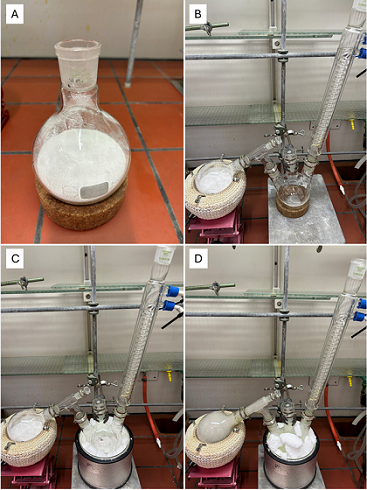
Figure 1. A. Thoroughly ground reaction mixture; B. Setup for pyrolysis; C. Start of heating; D. First formation of vapors after ca. 5 min of heating at Stage 2 (photos provided by the submitting authors)
After 20 min of distillation, the power control dial was increased to 90% (Note 12). After cessation of bubbling in the distillation flask, now containing a dark mixture (Note 13, Figure 2B), the heating was turned off and the apparatus was left to cool to 22 ℃. Residual water droplets and product in the 3-way adapter and reflux condenser were washed into the three-necked flask, using firstly 100 mL of water, followed by 150 mL of ethyl acetate. The biphasic mixture was then adjusted to a pH of 6 by addition of a 1 M KOH aqueous solution (as indicated by universal pH paper) while gently agitating the mixture by swirling the flask (Note 14). The resulting mixture was transferred to a 500-mL separatory funnel. The flask was rinsed twice with 25 mL of ethyl acetate, and the washings were added to the separatory funnel (Figure 2C). The phases were separated, and the aqueous phase was back-extracted three times with ethyl acetate (3 × 100 mL) (Figure 2D).
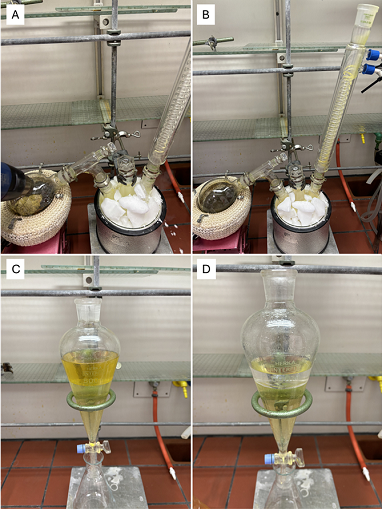
Figure 2. A. Additional heating of distillation setup with a heat gun; B. Finished distillation; C. Extraction setup; D. Last extraction with ethyl acetate (photos provided by the submitting authors)
The combined organic phases were dried using anhydrous Na2SO4 (50 g) and filtered through a glass funnel containing a cotton plug under a mild vacuum (approximately 60 mbar) into a tared 1 L round-bottom flask. The filter cake was washed with 25 mL of ethyl acetate (Figures 3A&B) and the volatiles were then removed on a rotary evaporator (Note 15) to yield crude 1 as a yellow solid (around 5.0 g) (Figure 3 C&D). Recrystallization from heptane/diethyl ether (3:1) afforded 1 as a yellow, crystalline solid (3.20 g, 28.6 mmol, 12% yield) (Notes 16,17,18,19,20) (Figure 4A, B). A second run of this procedure afforded 1 as a yellow, crystalline solid (4.12 g, 36.8 mmol, 15% yield).
Figure 3. A. Filtration of drying agent; B. Filtration after wash of drying agent with ethyl acetate; C. Solvent evaporation; D. Crude product 1 (photos provided by the submitting authors)
Figure 4. A. Recrystallization setup; B. Recrystallized product 1 (photos provided by the submitting authors)
B. 2-Oxo-2H-pyran-3-yl trifluoromethanesulfonate (2). A 400-mL Schlenk flask was charged with a rod-shaped magnetic stir bar (3 × 0.5 cm), fitted with a rubber septum (NS 14/19) and connected to a vacuum/argon manifold (Figure 5A). The flask was then evacuated, flame-dried and backfilled with argon, while cooling to ambient temperature. Then, under a stream of argon, the septum was briefly removed and 1 (5.21 g, 46.5 mmol, 1.00 eq.) was added. The septum was quickly re-attached to the flask, and anhydrous dichloromethane (135 mL, 0.35 M) was added to the flask in portions (3 x 45 mL) by piercing the septum with a 60 mL syringe equipped with an 18 G needle (Note 21) (Figure 5B). The resulting yellow solution was cooled in an ice-water bath (Figure 5C). After 5 min of cooling, with stirring, 2,4,6-trimethylpyridine (6.7 mL, 51.1 mmol, 1.1 eq.) (Note 22) was injected using a 10 mL syringe equipped with a 20 G needle. Then, trifluoromethanesulfonic anhydride (8.3 mL, 48.8 mmol, 1.05 eq.) (Note 23) was added dropwise using a 10 mL syringe equipped with a 20 G needle (Figure 5D), whereupon the reaction mixture turned intense red. The reaction mixture was stirred for 1 h in the ice-water bath (Note 24).
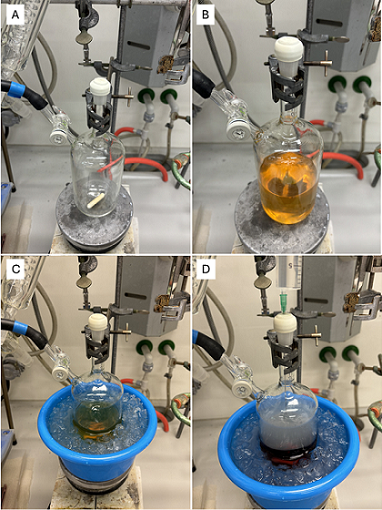
Figure 5. A. Reaction setup; B. Dissolved starting material in dichloromethane; C. Cooling of the reaction mixture to 0 ℃; D. Addition of triflic anhydride at 0 ℃; (photos provided by the submitting authors)
Following this reaction time, a 2 M aqueous solution of HCl (150 mL) was added at 0 ℃ (Figure 6A). The resulting mixture was allowed to warm to 22 ℃ (Figure 6B) and subsequently transferred to a 500-mL separatory funnel. The reaction flask was rinsed twice with 25 mL of dichloromethane, and the washings were transferred to the separatory funnel (Figure 6C). The phases were separated, and the aqueous phase was back-extracted with dichloromethane (2 × 150 mL) (Figure 6D). The combined organic phases were washed sequentially with 2 M HCl and brine (150 mL each), and the washed solution was dried over anhydrous Na2SO4 (50 g).
Figure 6. A. Quenching of the reaction mixture; B. Biphasic mixture after quench; C. Extraction/wash setup; D. Last extraction with dichloromethane (photos provided by the submitting authors)
The dried solution was filtered through a glass funnel containing a cotton plug under a mild vacuum (approximately 60 mbar) into a 1-L round-bottomed flask, the filter cake was washed with 25 mL of dichloromethane (Figure 7A). The volatiles were removed in vacuo (Note 25). The crude material was redissolved in dichloromethane (15 mL) and filtered through a silica plug (Note 26) (Figure 7B) into a 2-L round-bottom flask. The product was eluted using 1 L of toluene (Figure 7C), which was collected in its entirety. Volatiles were then removed in vacuo using a rotary evaporator (Note 27), and the product was further dried on high vacuum for 4 h (Note 28) to yield 2 as a yellow to orange, crystalline solid (10.22 g, 41.9 mmol, 90% yield) (Figure 7D) (Notes 29, 30).
Figure 7. A. Filtration of drying agent; B. Setup silica plug; C. Elution with toluene; D. Product 2 (photos provided by the submitting authors)
2. Notes
1. Prior to performing each reaction, a thorough hazard analysis and risk assessment should be carried out with regard to each chemical substance and experimental operation on the scale planned and in the context of the laboratory where the procedures will be carried out. Guidelines for carrying out risk assessments and for analyzing the hazards associated with chemicals can be found in references such as Chapter 4 of "Prudent Practices in the Laboratory" (The National Academies Press, Washington, D.C., 2011; the full text can be accessed free of charge at
https://www.nap.edu/catalog/12654/prudent-practices-in-the-laboratory-handling-and-management-of-chemical. See also "Identifying and Evaluating Hazards in Research Laboratories" (American Chemical Society, 2015) which is available via the associated website "Hazard Assessment in Research Laboratories" at
https://www.acs.org/about/governance/committees/chemical-safety.html. In the case of this procedure, the risk assessment should include (but not necessarily be limited to) an evaluation of the potential hazards associated with
mucic acid,
monopotassium phosphate (
KH2PO4),
phosphorus pentoxide (
P2O5),
2,4,6-trimethylpyridine, and
trifluoromethanesulfonic anhydride, as well as the proper procedures for operating heating mantles and heating apparatuses with heat guns
.2.
Mucic acid (>97.0%) was purchased from TCI and used as received.
3.
KH2PO4 (anhydrous, ≥99%) was purchased from Sigma-Aldrich and used as received.
4.
P2O5 (anhydrous, 99%) was purchased from Sigma-Aldrich and used as received.
5. The mixture was powdered until no further crushing of
KH2PO4 crystals could be felt (about 30 min for 0.25 mol scale).
6. All glass joints were fitted with PTFE sealing rings (Glindemann) and tightly sealed.
7. The three-way adapter can be equipped with a thermometer to monitor the temperature of the vapors within the adapter. The temperature of the vapors ranged from 90 to 150 ℃. Monitoring the temperature has no influence on the yield or rate of the reaction.
8. The receiving flask was covered with dry ice above the Dewar vessel rim for additional cooling.
9. The checking authors used a Glas-Col Series O/500-mL heating mantle and Optichem controller. The submitting authors used: Isopad Pilz G2/500 mL, 200 W heating mantle which reaches a maximal temperature of
ca. 350 ℃ at stage 2 and
ca. 430 ℃ at stage 3.
10. The submitting authors set their control dial to stage 2.
11. The water droplets can be heated without issue. The sublimated product was heated carefully as too much heating can lead to decomposition (indicated by browning of the solid).
12. The submitting authors set their control dial to stage 3.
13. The distillation flask can be washed clean with multiple rinses of saturated sodium bicarbonate.
14. The pH of the mixture after the reaction is around 3. An average of 25 mL of aqueous 1 M
KOH was needed to achieve pH 6.
15. Conditions for rotary evaporation: 35 ℃, 180 mbar. The low heating bath temperature is employed to avoid sublimation of the product.
16. The crude product was transferred to a one-necked 500-mL round-bottomed flask containing a football-shaped magnetic stir bar (3 × 1 cm), and the flask was then fitted with a reflux condenser attached to water circulation. To the flask was added 50 mL of
heptane/
diethyl ether (3:1), and the solution was heated to 75 ℃ using an oil bath. Additional portions of the 3:1
heptane/
diethyl ether solvent mixture was added until all the solids had dissolved (typically 30 to 35 mL/g crude
1). The resulting solution was heated for 5 min, after which the oil bath was removed to slowly cool the saturated solution. After reaching 22 ℃, the flask was stoppered and transferred to the freezer for crystallization overnight at -20 ℃. The precipitated crystals were then filtered through a medium porosity fritted 150 mL glass funnel (under a mild vacuum of approximately 60 mbar) and left on the same fritted funnel for 2 h to fully dry. The remaining solution was concentrated
in vacuo and the recrystallization procedure was repeated an additional time.
17. Heating above 75 ℃ should be avoided during recrystallization to prevent the product from melting and decomposing. In case of decomposition, indicated by brown discoloration of the solid or formation of a brown oil at the bottom of the flask, the supernatant solution can be decanted, filtered and left to crystallize.
18.
3-Hydroxy-2H-pyran-2-one (
1):
1H NMR
pdf (400 MHz, CDCl
3) δ 7.16 (dd,
J = 5.2, 1.7 Hz, 1H), 6.67 (dd,
J = 7.1, 1.7 Hz, 1H), 6.21 (dd, J = 7.1, 5.2 Hz, 1H), 6.10 (br, 1H) ppm;
13C NMR
pdf (101 MHz, CDCl
3) δ 161.8, 142.6, 142.3, 114.6, 107.3 ppm; FT-IR (ATR): 3191, 3086, 1675, 1630, 1576, 1559, 1431, 1415, 1290, 1220, 1125, 1059, 1029, 926, 905, 889, 832, 770, 760, 741, 650 cm
-1; HRMS (ESI): calculated for [M+H]
+ (C
5H
5O
3)
+: 113.0233; found 113.0254; mp = 85-87 ℃.
19. Product
1 is of 99% purity as measured by quantitative
1H NMR
pdf using mesitylene (TCI, 97%) as internal standard.
20. The submitting authors report a yield of 22%.
21.
Dichloromethane (anhydrous, ≥99.8%) was purchased from Thermo-Fischer Scientific and used as received.
22.
2,4,6-Trimethylpyridine (>98%) was purchased from TCI and used as received.
23.
Trifluoromethanesulfonic anhydride (99%) was purchased from TCI and used as received. The submitting authors purchased from Sigma-Aldrich and used as received.
24. The reaction process was monitored by TLC analysis on TLC plates purchased from Merck (TLC Silica gel 60 F254) (Figure 8). Compound
2 R
f = 0.51 (20%
ethyl acetate in
toluene, silica on aluminum, UV detection)
Figure 8. TLC analysis of reaction mixture (20% ethyl acetate in toluene). SM: Compound 1, C: co-spot, R50 min: reaction mixture after 50 min (photos provided by the submitting authors)
25. Conditions for rotary evaporation are 40 ℃ at 700 mbar.
26. A medium porosity fritted glass funnel (diameter of 5 cm, height of 8 cm) was charged with silica (Silica 60, 40 - 63 μm, purchased from Sorbtech (submitting authors used Macherey-Nagel brand silica)) and the crude product solution was carefully applied on top of the dry silica (height of silica plug was 4.5 cm) with a Pasteur pipette. For the elution with
toluene, a mild vacuum was applied by connecting to a water aspirator pump.
27. Conditions for rotary evaporation are 50 ℃ at 15 mbar.
28. High vacuum drying conditions were at 7 mbar.
29.
2-Oxo-2H-pyran-3-yl trifluoromethanesulfonate (
2):
1H NMR
pdf (400 MHz, CDCl
3) δ 7.52 (dd,
J = 5.1, 1.8 Hz, 1H), 7.36 (dd,
J = 7.2, 1.8 Hz, 1H), 6.31 (dd,
J = 7.2, 5.1 Hz, 1H) ppm;
13C NMR
pdf (101 MHz, CDCl
3) δ 156.2, 151.4, 136.3, 133.1, 117.1 (q,
J = 320.8 Hz), 104.9 ppm;
19F NMR
pdf (376 MHz, CDCl
3) δ -73.13 (s, 3F) ppm; FT-IR (ATR): 1723, 1641, 1548, 1420, 1349, 1242, 1208, 1180, 1135, 1108, 1043, 1005, 965, 915, 824, 797, 766, 707, 631 cm
‐1. HRMS (ESI): calculated for [M+Na]
+ (C
6H
3F
3O
5SNa)
+: 266.9545; found 266.9556; m.p. = 54-56 ℃.
30. Product
2 was determined to be 98% pure as measured by quantitative
1H NMR
pdf using mesitylene (TCI, 97%) as internal standard.
Working with Hazardous Chemicals
The procedures in
Organic Syntheses are intended for use only by persons with proper training in experimental organic chemistry. All hazardous materials should be handled using the standard procedures for work with chemicals described in references such as "Prudent Practices in the Laboratory" (The National Academies Press, Washington, D.C., 2011; the full text can be accessed free of charge at
http://www.nap.edu/catalog.php?record_id=12654). All chemical waste should be disposed of in accordance with local regulations. For general guidelines for the management of chemical waste, see Chapter 8 of Prudent Practices.
In some articles in Organic Syntheses, chemical-specific hazards are highlighted in red "Caution Notes" within a procedure. It is important to recognize that the absence of a caution note does not imply that no significant hazards are associated with the chemicals involved in that procedure. Prior to performing a reaction, a thorough risk assessment should be carried out that includes a review of the potential hazards associated with each chemical and experimental operation on the scale that is planned for the procedure. Guidelines for carrying out a risk assessment and for analyzing the hazards associated with chemicals can be found in Chapter 4 of Prudent Practices.
The procedures described in Organic Syntheses are provided as published and are conducted at one's own risk. Organic Syntheses, Inc., its Editors, and its Board of Directors do not warrant or guarantee the safety of individuals using these procedures and hereby disclaim any liability for any injuries or damages claimed to have resulted from or related in any way to the procedures herein.
3. Discussion
2-Pyrones constitute an important compound class due to their synthetic utility in the construction of complex scaffolds
via efficient and highly selective Diels-Alder reaction, as well as their occurrence in various bioactive natural products.
3,4 Depending on the electronics of their substituents, pyrones can engage either in normal-electron-demand or inverse-electron demand [4+2]-cycloadditions with electron-poor or electron-rich dienophiles, respectively.
5 This reaction enables access to bridged bicyclic lactones or, after CO
2 extrusion in a retro-Diels-Alder process, 1,3-cyclohexadienes, which further enhances the versatility and synthetic usefulness of this building block.
6This report describes the preparation of a versatile electrophilic reagent, 2-oxo-2
H-pyran-3-yl trifluoromethanesulfonate (
2), on large scale (10 g) enabling access to a variety of 3-substituted 2-pyrones. Previous work by our group has shown that this 2-pyrone derivative can be utilized in palladium-catalyzed cross-coupling reactions with boronic acids and esters, as well as alkyl boranes to introduce aryl, alkenyl and alkyl substituents at the 3-position of the 2-pyrone in good to excellent yields (Scheme 1).
7Scheme 1. Modular synthesis of 3-substituted 2-pyrones.
Application of this method and other coupling reactions involving this electrophilic 2-pyrone derivative include the syntheses of several natural products
8,9,10, complex scaffolds
11 and heterocycles
12 (Scheme 2).
Scheme 2: Literature examples of the use of 2 in natural product synthesis.
Appendix
Chemical Abstracts Nomenclature (Registry Number)
Mucic acid; (526-99-8)
Potassium dihydrogen phosphate; (7778-77-0)
Phosphorus pentoxide; (1314-56-3)
2,4,6-Trimethylpyridine; (108-75-8)
Trifluoromethanesulfonic anhydride; (358-23-6)

|
Konstantin Günther studied chemistry at the Humboldt University of Berlin. After a bachelor thesis on photomagnetic molecular switches with Prof. Oliver Dumele, he then joined the group of Prof. Ken'ichirō Itami at Nagoya University for his master thesis on the synthesis of water-soluble aromatic nanobelts. Currently, he is a graduate student at the University of Vienna and the Center of Molecular Medicine (CeMM). Under the supervision of Prof. Nuno Maulide, he conducts research on the synthesis and target identification of novel macrocyclic immunosuppressants. |

|
Lorenz Erlbacher studied chemistry at the University of Vienna, undertaking his master's research in the group of Prof. Nuno Maulide. Currently, he is a graduate student at the University of Vienna. Under the supervision of Prof. Nuno Maulide, he conducts research on the synthesis and target identification of novel macrocyclic immunosuppressants. |

|
Daniel Kaiser received his PhD at the University of Vienna in 2018, completing his studies under the supervision of Prof. Nuno Maulide. After a postdoctoral stay with Prof. Varinder K. Aggarwal at the University of Bristol, he returned to Vienna in 2020 to assume a position as senior scientist in the Maulide group. His current research focuses on the chemistry of destabilized carbocations and related high-energy intermediates. |

|
After obtaining his Ph.D. at the Université catholique de Louvain under the supervision of Prof. István E. Markó in 2007 Nuno Maulide pursued a postdoctoral position in the group of Prof. Barry M. Trost at Stanford University. In 2009, he started his independent career at the Max-Planck Institut für Kohlenforschung and only 4 years later, in 2013 he became a Full Professor at the University of Vienna. His research interests are broadly spread in the field of organic chemistry and include the development of new reaction methods, the total synthesis of natural compounds and medicinal chemistry driven investigations. He is a member of the Board of Editors for Organic Syntheses (2018), as well as an Associate Editor of Organic Letters (2018) and JACS AU (2020). |

|
Bryce Dye studied chemistry at Northern Kentucky University where he worked under the supervision of Amber Onorato. The focus of his undergraduate research was on the synthesis of small molecule prostaglandin inhibitors. After obtaining his B.S. in 2020, he began pursuing his Ph.D. at the University of Notre Dame. Under the direction of Richard E. Taylor, his graduate research focuses on the total synthesis of a biologically relevant polyketide natural product possessing remarkable conformational rigidity, apicularen A. |

|
Rich Taylor obtained his Ph.D. under the direction of Arthur G. Schultz at Rensselaer Polytechnic Institute. He was a postdoctoral research fellow at Stanford University under the mentorship of Paul A. Wender where he developed a synthesis of the anti-cancer diterpene, Taxol. He began his independent career at the University of Notre Dame where he is currently Professor of Chemistry & Biochemistry. His research interests include the application of chemical synthesis to the study of the therapeutic potential of natural products with an emphasis on the relationship between chemical structure and molecular conformation. He is currently a member of the leadership team for Organic Syntheses including Associate Editor. |
Copyright © 1921-, Organic Syntheses, Inc. All Rights Reserved