Org. Synth. 2026, 103, 236-252
DOI: 10.15227/orgsyn.103.0236
Organic Superbase t-Bu-P4 Catalyzed Concerted Nucleophilic Aromatic Substitution
Submitting Authors: Ozora Sasamoto
1a, Biswajit Das
1a, and Masanori Shigeno*
1a,bChecking Authors: Hayato Machii
2, Hirofumi Ueda
2, and Hidetoshi Tokuyama*
21. Procedure (Note 1)
A. 2-Phenyl-2-(pyridin-3-yl)propanenitrile (3a). A 50-mL Schlenk flask equipped with a 2.5 cm Teflon-coated magnetic stir bar and a rubber septum is charged with 6.02 g of 4A molecular sieves (Note 2). The flask is dried by heating with a heat gun under vacuum (4.7 mmHg) for 5 min. After cooling to room temperature (Note 3), the flask is refilled with argon. 3-fluoropyridine (1a) (1.02 mL, 1.16 g, 12.0 mmol, 1.0 equiv) (Note 4), 2-phenylpropanenitrile (2) (1.60 mL, 1.58 g, 12.0 mmol, 1.0 equiv) (Note 5), and anhydrous toluene (18 mL) (Note 6) are added to the flask via syringes (2.0-mL syringe with an 18G needle for each addition) through the rubber septum (Figure 1A). Then, t-Bu-P4 (0.8 M in hexane, 1.50 mL, 1.20 mmol, 10 mol %) (Note 7) is added to the flask via a gastight syringe (2.5-mL syringe with a 21-G needle) through the rubber septum (Figure 1B). The septum is then replaced with a greased glass stopper (Note 8) under argon flow. The stopper is secured with a Keck Clip, and the flask valve is closed (Figure 1C). The flask is disconnected from the Schlenk line, placed in a pre-heated oil bath at 100 ℃ (Note 9) (Figures 1D and 1E), and stirred at 800 rpm for 18 h (Figure 1F) (Note 10).
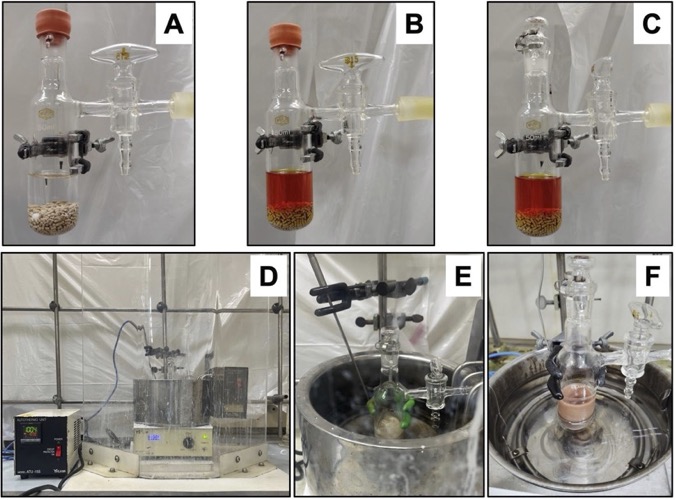
Figure 1. A. Reaction mixture before addition of t-Bu-P4; B. reaction mixture after addition of t-Bu-P4; C. sealed Schlenk flask with a glass stopper; D. reaction set-up; E. reaction mixture shortly after heating started; F. reaction mixture after 18 h. (Photos A-C and F were provided by the submitting authors and Photos D and E were provided by the checking authors.)
The flask is removed from the oil bath and allowed to cool to room temperature (20-25 ℃) (Figure 2A). The reaction is cooled to 0 ℃ with an ice bath and quenched by sequential addition of saturated ammonium chloride aqueous solution (10 mL) (Note 11) and H2O (10 mL) (Figure 2B). The mixture is filtered through a pad of Celite® (1 cm thick) (Note 12) under vacuum (22 mmHg) using a sintered glass filter (11G, 60 mL size) into a 200-mL round-bottom flask to remove 4A molecular sieves (Figure 2C) and washed with ethyl acetate (20 mL) (Note 13) and H2O (20 mL) (Figure 2D). The filtrate is transferred to a 500 mL separatory funnel. The aqueous layer is extracted with ethyl acetate (50 mL×3) (Figures 2E-2G). The combined organic layers are washed with brine (30 mL) (Figure 2H), dried over anhydrous sodium sulfate (20 g) (Note 14) in a 200-mL Erlenmeyer flask (Figures 2I and 2J), filtered using polypropylene funnel (top diameter 10 cm) plugged with cotton into a 1-L round-bottom flask (Figure 2K), and evaporated under reduced pressure (16 mmHg, 30 ℃) using a rotary evaporator to afford a crude oil as a clear brown liquid (Note 15) (Figure 2L).
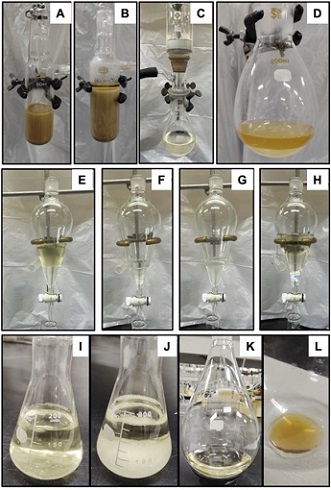
Figure 2. A. Reaction mixture after cooling to room temperature; B. reaction mixture after quenching; C. filtration set-up; D. filtrate; E. the first extraction; F. the second extraction; G. the third extraction; H. organic layer after washing with brine; I. organic layer before addition of sodium sulfate; J. organic layer after addition of sodium sulfate; K. organic layer after filtration; L. crude oil. (Photos A, B, D, and I-L were provided by the submitting authors and Photos C, and E-H were provided by the checking authors.)
The crude material is purified by column chromatography on silica gel (160 g) (Note 16) eluting with 50% (v/v) hexane (Note 17)/ethyl acetate (Figures 3A and 3B). The eluates are collected in test tubes (approximately 25 mL per fraction), and the target material is obtained in fractions from 27 to 53. These fractions are combined and concentrated under reduced pressure (35.3 mmHg, 30 ℃) using a rotary evaporator, followed by high vacuum (4.7 mmHg, room temperature) for 7 h to afford 2-phenyl-2-(pyridin-3-yl)propanenitrile (3a) (2.38 g, 11.4 mmol, 95%, 99.6% purity) (Note 18) as a pale-yellow oil (Figure 3C).
Figure 3. A. Set-up for silica gel column chromatography; B. silica gel column after loading of crude material; C. final product. (Photos were provided by the submitting authors)
2. Notes
1. Prior to performing each reaction, a thorough hazard analysis and risk assessment should be carried out with regard to each chemical substance and experimental operation on the scale planned and in the context of the laboratory where the procedures will be carried out. Guidelines for carrying out risk assessments and for analyzing the hazards associated with chemicals can be found in references such as Chapter 4 of "Prudent Practices in the Laboratory" (The National Academies Press, Washington, D.C., 2011; the full text can be accessed free of charge at
https://www.nap.edu/catalog/12654/prudent-practices-in-the-laboratory-handling-and-management-of-chemical. See also "Identifying and Evaluating Hazards in Research Laboratories" (American Chemical Society, 2015) which is available via the associated website "Hazard Assessment in Research Laboratories" at
https://www.acs.org/about/governance/committees/chemical-safety.html. In the case of this procedure, the risk assessment should include (but not necessarily be limited to) an evaluation of the potential hazards associated with 4A molecular sieves,
3-fluoropyridine,
2-phenylpropanenitrile,
phosphazene t-Bu-P4,
toluene,
ammonium chloride,
ethyl acetate,
sodium chloride,
sodium sulfate, silica gel,
hexane,
chloroform,
1,4-dimethoxybenzene, and
chloroform-d.
2. 4A Molecular sieves (diameter: 1.4-2.0 mm) were purchased from FUJIFILM Wako Pure Chemical Corporation and used as received.
3. In this procedure, the term "room temperature" refers to a temperature between 20 and 25 ℃.
4.
3-Fluoropyridine (>98%) was purchased from Tokyo Kasei Kogyo Co., Inc. and used as received without further purification.
5.
2-Phenylpropanenitrile (>98%) was purchased from Tokyo Kasei Kogyo Co., Inc. and used as received without further purification.
6.
Toluene, super dehydrated (>99.5%) was purchased from FUJIFILM Wako Pure Chemical Corporation and used as received without further purification.
7.
Phosphazene t-Bu-P4 hexane solution (0.8 M) was purchased from Sigma-Aldrich Co. LLC.
8. Silicone grease was purchased from DuPont Toray Specialty Materials Co., Ltd. and applied to the top of the glass stopper before sealing the reaction flask.
9. The temperature of the oil bath was maintained using the thermostat at 100 ℃.
10. Heating this reaction system may lead to pressure buildup. Therefore, the reaction should be conducted behind a blast shield as a safety precaution.
11.
Ammonium chloride (>98.5%) was purchased from Kanto Chemical Co., Inc. and used as received without further purification.
12. Celite
® (No. 545) were purchased from FUJIFILM Wako Pure Chemical Corporation and used as received.
13.
Ethyl acetate (99%) was purchased from Sigma-Aldrich Co. LLC. and used as received without further purification.
14. Anhydrous
sodium sulfate (>98.5%) was purchased from Kanto Chemical Co., Inc. and used as received without further purification.
15. Thin layer chromatography (TLC) analysis of the crude oil was performed using 50% (v/v)
hexane/
ethyl acetate as the eluent (Figure 4).
Figure 4. A. TLC analysis (hexane/ethyl acetate = 1:1, 254 nm); B. The plate visualized using a phosphomolybdic acid (PMA) stain. (Photos were provided by the submitting authors)
16. Silica gel 60 N (spherical, neutral, 63-210 μm) was purchased from Kanto Chemical Co., Inc. The silica gel (160 g) is wet-packed in a 5 cm diameter x 30 cm height column using 50% (v/v)
hexane/
ethyl acetate. Then, the crude oil diluted with a small amount of
chloroform (
Note 19) is loaded onto the column.
Figure 5. TLC analysis of fractions. The target material is obtained in fractions from 27 to 53 (Photo provided by the checking authors)
17.
Hexane (95.0%) was purchased from Kanto Chemical Co., Inc. and used as received without further purification.
18. The characterization data of
2-phenyl-2-(pyridin-3-yl)propanenitrile (
3a):
1H NMR
pdf (400 MHz, CDCl
3/TMS)
δ 8.67 (d, 1H,
J = 2.4 Hz), 8.58 (dd, 1H,
J = 4.8, 1.6 Hz), 7.68 (ddd, 1H,
J = 8.0, 2.4, 1.6 Hz), 7.39-7.28 (m, 6H), 2.13 (s, 3H).
13C NMR
pdf (100 MHz, CDCl
3)
δ 149.2, 147.9, 139.8, 137.0, 134.3, 129.1, 128.3, 126.4, 123.4, 122.3, 44.5, 27.7. HRMS (ESI)
m/z: ([M+H]
+) Calcd. for C
14H
14N
2+: 209.1073, found: 209.1075. IR (neat): 3033, 2237, 1575, 1494, 1479, 1447, 1417, 1381, 1338, 1075, 1021, 805, 761 cm
-1. The purity of compound
3a was determined by quantitative
1H NMR
pdf analysis using the mixture of compound
3a (31.2 mg, 0.150 mmol) and
1,4-dimethoxybenzene (23.4 mg, 0.158 mmol) (
Note 20) as an internal standard in
chloroform-d (
Note 21). To confirm the reproducibility, another reaction was carried out using 4A molecular sieves (6.08 g),
1a (1.02 mL, 1.16 g, 12.0 mmol),
2 (1.60 mL, 1.58 g, 12.0 mmol),
toluene (18 mL), and
t-Bu-P4 (0.8 M in
hexane, 1.5 mL) to afford desired compound
3a (2.38 g, 11.4 mmol, 95%, 99.6% purity)
19.
Chloroform (99%) was purchased from FUJIFILM Wako Pure Chemical Corporation and used as received without further purification.
20.
1,4-Dimethoxybenzene (99.8%) was purchased from Tokyo Kasei Kogyo Co., Inc. and used as received without further purification.
21.
Chloroform-d (99.8%) was purchased from Eurisotop (Saint‐Aubin, France).
Working with Hazardous Chemicals
The procedures in
Organic Syntheses are intended for use only by persons with proper training in experimental organic chemistry. All hazardous materials should be handled using the standard procedures for work with chemicals described in references such as "Prudent Practices in the Laboratory" (The National Academies Press, Washington, D.C., 2011; the full text can be accessed free of charge at
http://www.nap.edu/catalog.php?record_id=12654). All chemical waste should be disposed of in accordance with local regulations. For general guidelines for the management of chemical waste, see Chapter 8 of Prudent Practices.
In some articles in Organic Syntheses, chemical-specific hazards are highlighted in red "Caution Notes" within a procedure. It is important to recognize that the absence of a caution note does not imply that no significant hazards are associated with the chemicals involved in that procedure. Prior to performing a reaction, a thorough risk assessment should be carried out that includes a review of the potential hazards associated with each chemical and experimental operation on the scale that is planned for the procedure. Guidelines for carrying out a risk assessment and for analyzing the hazards associated with chemicals can be found in Chapter 4 of Prudent Practices.
The procedures described in Organic Syntheses are provided as published and are conducted at one's own risk. Organic Syntheses, Inc., its Editors, and its Board of Directors do not warrant or guarantee the safety of individuals using these procedures and hereby disclaim any liability for any injuries or damages claimed to have resulted from or related in any way to the procedures herein.
3. Discussion
Nucleophilic aromatic substitution (S
NAr) reactions of fluoroarenes are fundamental organic reactions that enable the functionalization of aromatic rings with nucleophiles. The classical S
NAr reaction proceeds via a stepwise mechanism: nucleophilic addition at the
ipso-carbon of a fluoroarene moiety generates a Meisenheimer intermediate, from which fluoride is subsequently eliminated.
3 Although S
NAr reactions are widely used in organic synthesis, their substrate scope is generally limited to electron-deficient fluoroarenes bearing strong electron-withdrawing groups (e.g., nitro, cyano, and carbonyl moieties) at the
ortho or
para positions, which help stabilize the intermediate. In contrast, reactions of electron-neutral or electron-rich fluoroarenes in the presence of a strong base often proceed through a base-promoted
ortho-deprotonation pathway, leading to the formation of aryne intermediates.
4 Consequently, these reactions typically afford mixtures of
ipso- and
ortho-substituted products.
Recently, concerted nucleophilic aromatic substitution (CS
NAr) reactions-in which nucleophilic addition and fluoride elimination occur in a single step-have attracted increasing attention.
5 This mechanism bypasses the formation of a Meisenheimer intermediate and offers broader substrate compatibility, including electron-rich fluoroarenes. Several research groups have demonstrated the applicability of this reaction to electronically non-activated substrates (Figure 5).
6 However, a general and catalytic approach to CS
NAr reactions has remained undeveloped.
Figure 6. A) CSNAr reactions using a stoichiometric strong base6a-6d; B) N-heterocyclic-carbene-catalyzed intramolecular CSNAr reactions6e,6f; C) CSNAr reactions using perfluoroarenes as a substrate6g,6h
In 2024, our group reported that the phosphazene base
t-Bu-P4 efficiently catalyzed CS
NAr reactions of fluoroarenes.
7 A range of electron-deficient and electron-rich fluoroarenes underwent smooth substitution with alkyl cyanides, furnishing the corresponding
ipso-substituted products in good-to-high yields (Table 1,
3b-3l). The chemoselective substitution of halogenated fluorobenzenes was also successfully achieved (Table 1,
3m-3o).
Table 1. Representative t-Bu-P4-catalyzed CSNAr reactions with alkylcyanide 2.a,b aReactions were conducted on a 0.2 mmol scale. bIsolated yields. cReaction was conducted at 40 ℃. dReaction was conducted at 60 ℃. eReaction was conducted at 140 ℃. fReaction was conducted at 120 ℃. gReaction was conducted in mesitylene at 180 ℃.
Reactions of 1,1'-fluorobiphenyl (1p) with various heteroatom-containing nucleophiles, including alcohols, amines, thiols, and phosphines, also proceeded efficiently to give the corresponding desired products in good yields (Table 2, 9-12). In contrast, carbon nucleophiles bearing electron-withdrawing groups (e.g., carbonyl, nitro, or trifluoromethyl) at the benzylic position were ineffective, likely because of their low nucleophilicities (Table 2, 13).
Table 2. Representative t-Bu-P4 catalyzed CSNAr reactions with various nucleophiles.a,b aReactions were conducted on a 0.2 mmol scale. bIsolated yields. cReaction was conducted in DMI. dReaction was conducted in mesitylene at 160 ℃. eReaction was conducted at 140 ℃ fThe yields were determined by 1H NMR using 1,1,2-trichloroethane as an internal standard.
In summary, the t-Bu-P4-catalyzed CSNAr methodology enables efficient SNAr reactions of fluoroarenes, regardless of their electronic nature. The broad nucleophilic compatibility of SNAr reactions with alkyl cyanides, alcohols, amines, thiols, and phosphines highlights their utility as a versatile platform for synthetic applications in the fields of materials science and pharmaceutical chemistry
Appendix
Chemical Abstracts Nomenclature (Registry Number)
2-phenyl-2-(pyridin-3-yl)propanenitrile: 3-pyridineacetonitrile, α-methyl-α-phenyl-; (3041055-55-1)
4A molecular sieves: Zeolite 4A; (70955-01-0)
3-fluoropyridine: 3-fluoropyridine; (372-47-4) (1a)
2-phenylpropanenitrile: 2-phenylpropionitrile; (1823-91-2) (2)
t-Bu-P4: N'''-(1,1-Dimethylethyl)-N,N',N''-tris[tris(dimethylamino)phosphoranylidene]phosphorimidic triamide; (111324-04-0)
|
Ozora Sasamoto was born in Nagoya, Japan in 1995. He received his B.S. (2018), M.S. (2020), and Ph.D. (2023) from Kanazawa University (Japan) under the direction of Professor Munetaka Kunishima. In 2023, He was appointed as an assistant professor of Department of Biophysical Chemistry, Graduate School of Pharmaceutical Science in Associate Professor Shigeno's group at Tohoku University. His research interests are the development of new methodologies for molecular transformation using base catalysts. |

|
Biswajit Das was born in Odisha, India in 1994. He received his B. Sc. (2014) from Kendrapara Autonomous College, M. Sc. (2016) from Berhampur University, M. Phil. (2018) from Sambalpur University and Ph. D. (2024) from National Institute of Technology Rourkela under the supervision of Associate Professor Debayan Sarkar. He has worked as an CSIR-Project fellow at Indian Institute of Technology Indore under Professor Debayan Sarkar. In 2024, he joined as Specially Appointed Assistant Professor in Professor Masanori Shigeno's group at Tohoku University. His research interests include discovery of new strategies for vital organic transformations employing catalysis. |

|
Masanori Shigeno is a Professor at Tohoku University. He was born in Shiga, Japan, in 1983 and received his B.Sc. (2005) and Ph.D. (2009) degrees from Kyoto University under the supervision of Professor Masahiro Murakami. In 2009, he joined the group of Professor Masahiko Yamaguchi at Tohoku University as an Assistant Professor. In 2012, he had the opportunity to work with Professor Ivan Huc at the Université de Bordeaux as a Visiting Assistant Professor for two months. He was promoted to Lecturer in 2016 in the group of Professor Yoshinori Kondo and then to Associate Professor in 2019. Since 2026, he has held his current position. He has also served as a PRESTO researcher of the Japan Science and Technology Agency (JST) from 2022 to 2026. His research interests include the development of new organic transformations and functional organic materials with unique properties. |

|
Hayato Machii was born in Tochigi, Japan in 2002. He received his B.S. (2025) from Tohoku University (Japan) under the supervision of Professor Hidetoshi Tokuyama. He is currently pursuing his Master course study at the same graduate school. His research interests are the area of the total synthesis of complex natural products. |

|
Hirofumi Ueda received his Ph.D. (2010) from Tohoku University under the direction of Professor Hidetoshi Tokuyama. After receiving the Ph.D., he started soon his academic carrier as an Assistant Professor in the same group. In 2018, he was promoted to lecturer and in 2023 to his current position of associate professor. He spent 7 months in 2019 at the University of California, Berkeley as a visiting scholar with Prof. Richmond Sarpong. His research interests center on the development of novel synthetic methodology involving oxidation, and applications to the synthesis of complex alkaloids and nitrogen-containing molecules. |
|
Hidetoshi Tokuyama is a Professor at Tohoku University. He received his Ph.D. from Tokyo Institute of Technology in 1994 under the supervision of Professor Ei-ichi Nakamura. He then joined the research group of Professor Amos B. Smith III at the University of Pennsylvania in Philadelphia. In 1995, he became an Assistant Professor in the group of Professor Tohru Fukuyama at the University of Tokyo. Since 2006, he has held his current position. His research focuses on total synthesis of complex natural products, development of synthetic methodologies, and medicinal chemistry. |
Copyright © 1921-, Organic Syntheses, Inc. All Rights Reserved