Org. Synth. 2026, 103, 347-361
DOI: 10.15227/orgsyn.103.0347
Mild Amide Synthesis with TCFH-NMI: Preparation of 1-Boc-4-(2-Furoyl)piperazine
Submitting Authors: Kasey K. Chung,
1 Gregory L. Beutner,*
†1 and David A. Vosburg*
1Checking Authors: Maris E. Podgurski and Christopher D. Vanderwal*
21. Procedure (Note 1)
1-tert-Butoxycarbonyl-4-(2-furoyl)piperazine (1). In a 500-mL, three-necked, round-bottom flask (24/40 joint) with a 2 cm x 1 cm football-shaped Teflon-coated magnetic stir bar, a nitrogen line is connected through a septum to the right neck, a stopper added to the center neck and a nested thermometer (-20 to 150 ℃ range) is added into the left neck (Figure 1A) (Note 2). The flask is placed in a 20 ℃ water bath and charged with acetonitrile (MeCN, 25 mL) (Note 3) and 2-furoic acid (5.01 g, 44.7 mmol, 1 equiv.) (Note 4). With stirring, N-methylimidazole (NMI, 7.5 mL, 92 mmol, 2.1 equiv.) (Note 5) and N-Boc piperazine (8.31 g, 44.6 mmol, 1.0 eq.) (Note 6) are charged subsequently. N,N,N',N'-Tetramethylchloroformamidinium hexafluorophosphate (TCFH, 13.8 g, 49.2 mmol, 1.1 equiv.) (Note 7) is added in 3 portions to keep the temperature of the reaction below 60 ℃ for the duration of the addition (Note 8). After TCFH addition is complete, the water bath is removed. At this point, a white slurry is observed. The reaction is stirred (400 rpm) for 3 h at 20 ℃ (Note 9). The stopper and nitrogen line are removed and a 500-mL dropping funnel is added. Then 225 mL of H2O is added dropwise over 1 h while stirring and the mixture is left stirring for an additional hour after the completion of the addition (Figure 1B).
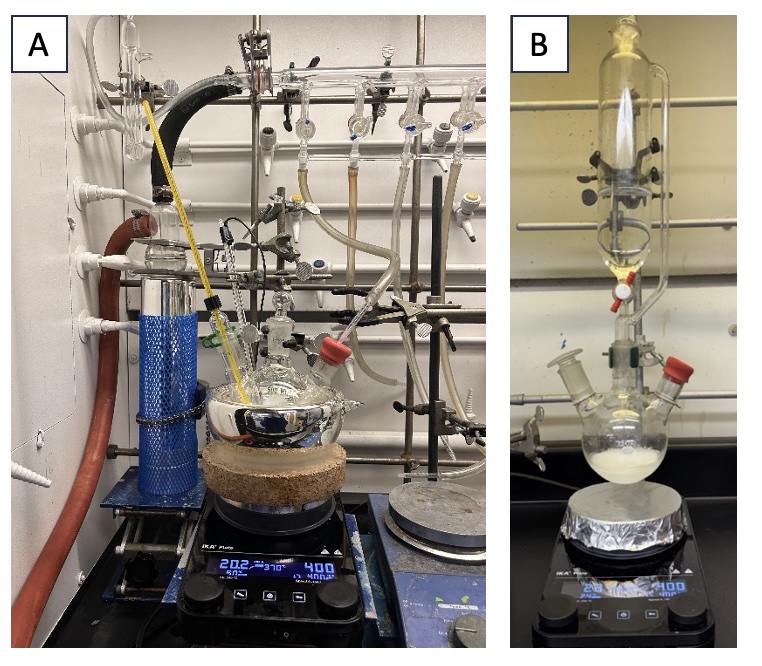
Figure 1: A. Reaction flask prior to addition of TCFH; B. Reaction during addition of water (photo A provided by checking authors and photo B provided by submitting authors)
The product is isolated by filtration using 7.0 cm qualitative filter paper No. 3 from Whatman on a Büchner funnel, and the flask is then rinsed with 2 x 25 mL washes of H2O. The Büchner funnel containing the solid is then fitted with a Kimwipe secured by a rubber band and dried under nitrogen sweep (ca 20 psi) for no less than 16 h (Figure 2), which yields 11.39 grams of 1-tert-butoxycarbonyl-4-(2-furoyl)piperazine (Run 1: 40.6 mmol, 91% yield, 100 wt% purity by qNMR; Run 2: 42.0 mmol, 94% yield, 98.8 wt% purity by qNMR) (Figure 3) as a white solid (Notes 10 and 11).
Figure 2. A. Setup for nitrogen sweep and vacuum drying of the crude product using a Büchner funnel fitted with a Kimwipe; B. Product as a white solid (photo provided by submitting authors)
2. Notes
1. Prior to performing each reaction, a thorough hazard analysis and risk assessment should be carried out with regard to each chemical substance and experimental operation on the scale planned and in the context of the laboratory where the procedures will be carried out. Guidelines for carrying out risk assessments and for analyzing the hazards associated with chemicals can be found in references such as Chapter 4 of "Prudent Practices in the Laboratory" (The National Academies Press, Washington, D.C., 2011; the full text can be accessed free of charge at
http://www.nap.edu/catalog.php?record_id=12654). See also "Identifying and Evaluating Hazards in Research Laboratories" (American Chemical Society, 2015) which is available via the associated website "Hazard Assessment in Research Laboratories" at
https://www.acs.org/about/governance/committees/chemical-safety.html. In the case of this procedure, the risk assessment should include (but not necessarily be limited to) an evaluation of the potential hazards associated with
N,N,N',N'-tetramethylchloroformamidinium hexafluorophosphate (
TCFH),
N-methylimidazole,
acetonitrile,
2-furoic acid,
N-Boc piperazine,
mesitylene, and
CDCl3.
2. The glassware and Teflon-coated magnetic stir bar were both oven-dried for 10 min prior to reaction setup.
3.
Acetonitrile (
MeCN, HPLC Plus,
>99.9%) was purchased from Sigma-Aldrich and used as received.
4.
2-Furoic acid (98%) was purchased from Sigma-Aldrich and used as received. This substrate was selected due to its biorenewable properties.
35.
N-Methylimidazole (
NMI, ReagentPlus, 99%) was purchased from Sigma-Aldrich and used as received.
NMI acts as a base (2 equivalents) and a catalytic nucleophile in the reaction (see Discussion for more details), so 2.1 equivalents are used.
6.
N-Boc piperazine (99.9%) was purchased from Chem-Impex and used as received. This substrate was chosen due to the prevalence of piperazine-containing compounds in drug discovery and FDA-approved drugs.
4 Also, product
1 is a precursor to the drug prazosin (see Figure 4).
7.
N,N,N',N'-Tetramethylchloroformamidinium hexafluorophosphate (
TCFH, 99.8%) was purchased from Chem-Impex and used as received.
8. An exotherm to 73 ℃ was observed when
TCFH was added in a single portion.
9. The progress of the reaction can be monitored through TLC using Silica G TLC Plates with UV
254 from Sorbent Technologies (Figure 3). The amide product is visible with an R
f of 0.40 in 1:1 heptanes:
EtOAc by UV lamp (254 nm), but does not stain with
p-anisaldehyde like
2-furoic acid does.
Figure 3. TLC of reaction progress (photo provided by submitting authors)
10. Characterization of
1 was performed with
chloroform-d (99.8% d from Sigma-Aldrich, used as received).
1H NMR
pdf (500 MHz,
CDCl3) δ: 7.45 (s, 1H), 6.98 (d, J = 3.5 Hz, 1H), 6.44 (dd, J = 3.5, 1.8 Hz, 1H), 3.73 (m, 4H), 3.46 (dd, J = 6.4, 4.0 Hz, 4H), 1.43 (s, 9H).
13C NMR
pdf (100 MHz,
CDCl3) δ: 159.2, 154.6, 147.8, 143.8, 116.8, 111.4, 80.3, 43.7 (broad), 28.4. IR (diamond-ATR, neat): 3128, 2859, 1687, 1625, 1567, 1483, 1423, 1391, 1285, 1251, 1229, 1185, 1158, 1148, 1124, 1027, 1010 cm
-1. m.p. 131 ℃. HRMS (EI): calculated for C
14H
20N
2O
4Na [M+Na]
+: 303.1322, found: 303.1324.
11. The purity of product
1 in the first run was determined using qNMR
pdf on a sample prepared by dissolving 33.0 mg of
1 and 13.5 mg of
mesitylene in
chloroform-d. The purity was determined to be 100 wt%. The purity of product
1 in the second run was determined using qNMR on a sample prepared by dissolving 37.5 mg of
1 and 16.3 mg of
mesitylene in
chloroform-d. The purity was determined to be 98.8 wt%.
Mesitylene (98%) was purchased from Sigma-Aldrich and used as received.
Working with Hazardous Chemicals
The procedures in
Organic Syntheses are intended for use only by persons with proper training in experimental organic chemistry. All hazardous materials should be handled using the standard procedures for work with chemicals described in references such as "Prudent Practices in the Laboratory" (The National Academies Press, Washington, D.C., 2011; the full text can be accessed free of charge at
http://www.nap.edu/catalog.php?record_id=12654). All chemical waste should be disposed of in accordance with local regulations. For general guidelines for the management of chemical waste, see Chapter 8 of Prudent Practices.
In some articles in Organic Syntheses, chemical-specific hazards are highlighted in red "Caution Notes" within a procedure. It is important to recognize that the absence of a caution note does not imply that no significant hazards are associated with the chemicals involved in that procedure. Prior to performing a reaction, a thorough risk assessment should be carried out that includes a review of the potential hazards associated with each chemical and experimental operation on the scale that is planned for the procedure. Guidelines for carrying out a risk assessment and for analyzing the hazards associated with chemicals can be found in Chapter 4 of Prudent Practices.
The procedures described in Organic Syntheses are provided as published and are conducted at one's own risk. Organic Syntheses, Inc., its Editors, and its Board of Directors do not warrant or guarantee the safety of individuals using these procedures and hereby disclaim any liability for any injuries or damages claimed to have resulted from or related in any way to the procedures herein.
3. Discussion
Acylation is an essential organic reaction that makes up approximately 22% of the reactions used to make pharmaceutically relevant compounds.
5 N-Acylation, or amidation, is the most commonly used acylation reaction in medicinal chemistry.
6 The abundance of amidation reactions makes the continuing development of environmentally friendly, industry-applicable protocols vital for sustainable organic synthesis.
Currently, there is an extremely wide variety of amide bond forming reagents to address the various challenges within this broad class of substrates.
7 Amides can be synthesized through traditional methods from acid chlorides, but formation of acid chlorides from carboxylic acids requires reagents like thionyl chloride and oxalyl chloride which are toxic and corrosive due to dangerous byproducts, such as HCl.
8A modern alternative that avoids the intermediacy of an acid chloride is 1-ethyl-3-(3-dimethylaminopropyl)carbodiimide (EDAC), a commonly used activator for process-scale amidation reactions.
9 In Graham
et al.'s evaluation of the occupational hazards that are caused by amide bond forming reagents, EDAC tested positive for dermal corrosion, eye irritation, and dermal sensitization; indeed, it is one of the most hazardous coupling reagents tested in that study.
10 EDAC and other carbodiimides all present occupational hazards to chemists-upon repeated exposure, these sensitizers can cause severe allergic reactions to those that handle them. As another example, propanephosphonic acid anhydride (T3P) is known for its lack of epimerization of labile α-stereocenters when forming amide bonds.
11 But T3P presents isolation issues due to formation of byproducts that require multiple aqueous washes to remove.
12 1-[Bis(dimethylamino)methylene]-1
H-1,2,3-triazolo[4,5-
b]pyridinium 3-oxide hexafluorophosphate (HATU) and related benzotriazole-containing compounds are both dermally sensitizing
10 and shock-sensitive,
13 posing an additional safety risk to scientists. Given exposure risks to sensitizers, alternate coupling reagents are worth using in lieu of such toxic and hazardous coupling reagents.
Using tetramethylchloroformamidinium hexafluorophosphate (TCFH) as opposed to these more common coupling reagents is beneficial in a number of ways. TCFH is commercially available at large scales since it is the common synthetic precursor to the uronium/guanadinium family of amide bond forming agents that includes HATU. Graham
et al. demonstrated that TCFH is not a skin sensitizer, setting it apart from other commonly used amide bond forming reagents such as EDAC, T3P, and HATU.
10 In addition, TCFH has been shown to be non-explosive, unlike other benzotriazole-containing compounds such as PyBOP and HATU.
13Combining TCFH with
N-methylimidazole (NMI) and a carboxylic acid gives direct access to
N-acyl imidazolium intermediates (
2, Scheme 1).
14 These intermediates are more potent electrophiles than
N-acyl imidazole intermediates formed with 1,1'-carbonyldiimidazole (CDI). Prior methods to access
N-acyl imidazoliums are challenging since they employ highly toxic methylating reagents which can lead to
N-methylated impurities, complicating isolation.
15Scheme 1: Mechanism for TCFH-NMI amidation
This amidation method, as demonstrated here, frequently allows for streamlined isolation due to its water-soluble by-products, including NMI salts
3 and tetramethylurea (
4). In most cases, the product precipitates out of solution upon the addition of water and does not require liquid-liquid extraction, column chromatography, or additional solvents for workup. This precipitation is enabled by the use of MeCN as a water-miscible and relatively green solvent
16 rather than the more commonly used dichloromethane (DCM), which is undesirable for this protocol due to its water immiscibility, toxicity, and current status as a regulated chemical.
17 Notably, most published routes to amide
1 use DCM and/or a sensitizing coupling reagent;
18 others use expensive reagents and require heating at 60-95 ℃.
19,20 Thus, TCFH-NMI in MeCN has advantages over other amide synthesis protocols due to enhanced safety, low cost, and the potential for facile isolations.
TCFH-NMI amidations are well-suited for the teaching laboratory and for chemical manufacturing due to their safety, rapid kinetics, mild conditions, and simple isolations. We developed an undergraduate laboratory experiment in which students use TCFH-NMI to prepare
1 or
5, a structural analogue of both the antihypertensive drug prazosin (
6) and the Parkinson's drug piribedil (
7, Figure 4).
21 Amide
1, the product of this
Organic Syntheses procedure, is also a precursor to
6.
Figure 4: Amides synthesized with TCFH-NMI in a teaching lab (1, 5)
21 and related drugs prazosin (6) and piribedil (7). The new amide bonds in 1 and 5 are highlighted in blue
Selected examples of amide products
8-
11 synthesized using TCFH-NMI at >100 g scale are shown in Figure 5.
12,22,23,24 These structures highlight the ability to use hindered amines (
8-
9), carboxylic acids bearing labile α-stereogenic centers (
9-
10), and even alternative nitrogen nucleophiles such as acylhydrazides in
11.
Figure 5: Representative amides synthesized on large scale with TCFH-NMI, with new amide bonds highlighted in blue
12,22,23,24ACT-1016-0707 is an LPA1 inhibitor antagonist for the treatment of fibrotic diseases,
22 and ACT-1004-1239 is a CXCR7 antagonist used to treat inflammatory demyelinating diseases.
23 The anti-cancer drug linrodostat has been made on a kilogram scale using a TCFH-NMI amidation.
12 BMS-986224 was also synthesized on a kilogram scale as a preventative treatment against systolic heart failure.
24 These references reported no or mild exotherms and easy isolation processes with the rejection of the PF
6 counterion in the product simply by addition of water. These examples, along with this
Organic Syntheses procedure, illustrate the scalability of TCFH-NMI amidation.
The combination of TCFH and NMI has proven effective in acylations to produce a wide range of amide products,
14 but has also enabled the synthesis of esters,
25 thioesters, and ketones
26 from carboxylic acids, further demonstrating the flexibility and generality of the method. A companion
Organic Syntheses procedure for ketone synthesis
27 and a recent review
28 underscore the broad utility of TCFH-NMI, even beyond acylation reactions.
The examples in Figures 4 and 5 and the procedure described in this article demonstrate the general applicability of the TCFH-NMI amidation method. Its safety, greenness, and easy isolation process make TCFH-NMI an excellent choice for amide synthesis in both industrial and academic chemistry laboratories.
Appendix
Chemical Abstracts Nomenclature (Registry Number)
2-Furoic acid; (88-14-2)
Acetonitrile; (75-05-8)
N-Methylimidazole: NMI; 1-Methylimidazole; (616-47-7)
N-Boc piperazine: 1-Boc piperazine; (57260-71-6)
N,N,N',N'-Tetramethylchloroformamidinium hexafluorophosphate:TCFH; Chloro-N,N,N′,N′-tetramethylformamidinium hexafluorophosphate; (94790-35-9)
1,3,5-Trimethylbenzene: mesitylene; (108-67-8)
tert-Butyl 4-(furan-2-carbonyl)piperazine-1-carboxylate; (163838-98-0)
|
Kasey Chung is from Los Angeles, CA and graduated from Harvey Mudd College (HMC) with a B.S. in Chemistry and Biology and an Emphasis in Environmental Analysis in 2025. She conducted undergraduate research in the laboratory of David Vosburg at HMC, where she worked mostly with TCFH chemistry, publishing methods on esterifications, ketone syntheses, and now amidations. She is currently pursuing a chemistry PhD in the group of Prof. Neil Garg at the University of California, Los Angeles. |

|
Dr. Gregory Beutner is from Wakefield, MA and graduated from Tufts University in 1998. He obtained his PhD with Prof. Scott Denmark at the University of Illinois, Urbana-Champaign. After completing his PhD in 2004, he was a NIH post-doctoral fellow with Prof. Robert H. Grubbs at the California Institute of Technology. He started his industrial career in the Merck Process Chemistry group in 2006 before moving to his current position in Chemical Process Development at Bristol Myers Squibb in New Brunswick NJ where he is a Scientific Director and focuses on using physical organic chemistry to solve challenges in the synthesis of pharmaceutically relevant compounds. |

|
David Vosburg is the Donald A. Strauss Professor of Chemistry at Harvey Mudd College, where he has taught since 2005. He received a B.A. in Chemistry from Williams College in 1997, working with J. Hodge Markgraf. He obtained his PhD from Scripps Research in 2002 with Erik J. Sorensen as an NSF Graduate Research Fellow and was a Jane Coffin Childs Postdoctoral Fellow with Christopher T. Walsh at Harvard Medical School. David is a Henry Dreyfus Teacher Scholar and pursues organic synthesis, green chemistry, and science-faith topics. He has three children and enjoys playing games, reading, and traveling. |
|
Maris Podgurski is a second-year PhD candidate studying the total synthesis of natural products in the lab of Prof. Chris Vanderwal at the University of California, Irvine. She graduated from Northeastern University with a B.S. in Chemistry with a Minor in Mathematics in 2024, where she worked on developing novel compounds demonstrating selective antimalarial activity in the laboratory of Prof. Roman Manetsch. |
|
Chris Vanderwal received a B.Sc. degree in Biochemistry and an M.Sc. degree in Chemistry from the University of Ottawa. He then moved to the Scripps Research Institute for PhD studies in the group of Professor Erik Sorensen. Chris next joined the group of Professor Eric Jacobsen at Harvard University as a Jane Coffin Childs postdoctoral associate. In 2005, Chris began his independent academic career at the University of California, Irvine, where he has been ever since, currently as Professor of Chemistry and of Pharmaceutical Sciences. Chris's group focuses on the synthesis of complex natural products, including alkaloids, terpenoids, and polyhalogenated secondary metabolites. |
Copyright © 1921-, Organic Syntheses, Inc. All Rights Reserved