Org. Synth. 2026, 103, 334-346
DOI: 10.15227/orgsyn.103.0334
Mild Pyrrole C-Acylation Using TCFH-NMI: Synthesis of Methyl 4-(3,5-Dimethyl-1H-pyrrol-2-yl)-4-oxobutanoate
Submitting Authors: Grant H. Miller,
1 Gregory L. Beutner,*
†1 and David A. Vosburg*
1Checking Authors: Alana Rose Meyer and Tehshik P. Yoon*
21. Procedure (Note 1)
Methyl 4-(3,5-dimethyl-1H-pyrrol-2-yl)-4-oxobutanoate (1). A 300-mL, three-necked, round-bottom flask (24/40 joint) equipped with a 2 cm × 1 cm football-shaped Teflon-coated magnetic stir bar is fitted with two rubber septa and a glass stopper (Note 2). A nitrogen inlet needle is inserted through one septum to the bottom of the flask, and a vent needle is inserted through the second septum to maintain a slow, continuous flow of nitrogen (Figure 1). The additions are performed under an atmosphere of nitrogen, temporarily pausing nitrogen flow during the addition of solids. The flask is charged with monomethyl succinate (5.00 g, 37.8 mmol, 1.00 equiv) (Note 3) and acetonitrile (50 mL, 10 mL/g substrate) (Note 4).
Figure 1. A. Addition of monomethyl succinate to a nitrogen-purged flask; B. Reaction flask after addition of acetonitrile
1-Methylimidazole (NMI, 6.4 mL, 80 mmol, 2.1 equiv) (Note 5) is then added via syringe through a septum, followed by addition of 2,4-dimethylpyrrole (4.4 mL, 42 mmol, 1.1 equiv) (Note 6) via syringe through a septum (Figure 2).
Figure 2. Reaction flask after addition of 1-methylimidazole and 2,4-dimethylpyrrole via syringe through the septum
N,N,N',N'-Tetramethylchloroformamidinium hexafluorophosphate (TCFH, 12.9 g, 45.4 mmol, 1.2 equiv) (Note 7) is added rapidly in a single portion. The reaction mixture is sparged with a long needle for 5 min to degas the solution. The reaction is then maintained under a nitrogen atmosphere by removing the vent needle and the sparging needle (Figure 3).
Figure 3. A. Sparging of the reaction mixture following addition of TCFH; B. Reaction flask sealed under nitrogen atmosphere prior to stirring.
The reaction mixture is stirred (330 rpm) at room temperature (25 °C) for 18 h (Note 8). The resulting slightly cloudy solution is diluted slowly with water (100 mL) added via a dropping funnel, causing immediate precipitation of a white solid. The mixture is aged with stirring at room temperature (25 °C) for 1 h. The solid is collected by vacuum filtration in a 150 mL medium porosity fritted Büchner funnel (Figure 4). Water/acetonitrile (3:1, 25 mL) is added to the solids and agitated with a spatula before applying vacuum to remove the liquid. Methyltert-butyl ether (MTBE, 25 mL) is added to the solids and agitated with a spatula before applying vacuum to remove the liquid (Note 9). The product is dried under vacuum with a nitrogen sweep for 18 h (Figure 5) to afford 1 (6.02 g, 76% yield, 98 wt% purity by qNMR, m.p. 163-165 °C, DSC) as an off-white solid (Notes 10, 11, and 12).
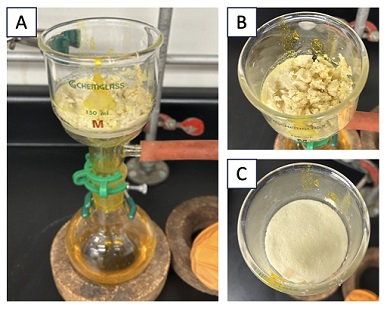
Figure 4. A. Collection of the crude product by vacuum filtration in a Büchner funnel following aqueous dilution and aging; B. Crude product immediately after filtration; C. Product appearance after sequential washes with water/acetonitrile (3:1) and methyltert-butyl ether(MTBE)
Figure 5. Setup for nitrogen sweep and vacuum drying of the crude product using a Büchner funnel fitted with a Kimwipe and rubber band
2. Notes
1. Prior to performing each reaction, a thorough hazard analysis and risk assessment should be carried out with regard to each chemical substance and experimental operation on the scale planned and in the context of the laboratory where the procedures will be carried out. Guidelines for carrying out risk assessments and for analyzing the hazards associated with chemicals can be found in references such as Chapter 4 of "Prudent Practices in the Laboratory" (The National Academies Press, Washington, D.C., 2011; the full text can be accessed free of charge at
https://www.nap.edu/catalog/12654/prudent-practices-in-the-laboratory-handling-and-management-of-chemical. See also "Identifying and Evaluating Hazards in Research Laboratories" (American Chemical Society, 2015) which is available via the associated website "Hazard Assessment in Research Laboratories" at
https://www.acs.org/about/governance/committees/chemical-safety.html. In the case of this procedure, the risk assessment should include (but not necessarily be limited to) an evaluation of the potential hazards associated with
TCFH,
NMI,
monomethyl succinate,
2,4-dimethylpyrrole,
acetonitrile, and
methyltert-butyl ether.
2. The glassware and Teflon-coated magnetic stir bar were both oven-dried for 10 minutes prior to reaction setup.
3.
Monomethyl succinate (mono-methyl hydrogen succinate or 4-methoxy-4-oxobutanoic acid) (95%) was purchased from Sigma-Aldrich and used as received.
4.
Acetonitrile (99.9%, HPLC Plus grade) was purchased from Sigma-Aldrich and used as received.
5.
1-Methylimidazole (
N-methylimidazole,
NMI 99%) was purchased from Sigma-Aldrich and used as received.
6.
2,4-Dimethylpyrrole was purchased from Sigma-Aldrich and used as received. Two different bottles were used across separate runs, with weight purities ranging from 92.5% to 97.6%.
7.
N,N,N′,N′-Tetramethylchloroformamidinium hexafluorophosphate (
TCFH, 99.8%) was obtained from Chem-Impex and used as received.
8. The progress of the reaction can be monitored through TLC using Silica G TLC Plates with UV
254 from Sorbent Technologies. The ketone product is visible with an R
f of 0.27 in 7:3 heptanes:
EtOAc by UV lamp (254 nm).
Figure 6. TLC of reaction progress
9.
Methyltert-butyl ether (
MTBE, 99.0%) was obtained from Sigma-Aldrich and used as received.
10. Characterization of
1 was performed with
chloroform-d (99.8% d from Sigma-Aldrich, used as received).
1H NMR
pdf (500 MHz, CDCl
3)
TM: 9.22 (bs, 1H), 5.82 (s, 1H), 3.70 (s, 3H), 3.04 (t, 2H,
J = 6.8 Hz), 2.73 (t, 2H,
J = 6.7 Hz), 2.37 (s, 3H), 2.24 (s, 3H).
13C NMR
pdf (126 MHz, CDCl
3): 186.8, 173.7, 134.6, 128.6, 128.0, 112.7, 51.8, 34.2, 28.1, 14.6, 13.0. IR (diamond-ATR, neat): 1731, 1614, 1487, 1434, 1367, 1206, 1162 cm
-1. HRMS (TOF-MS/ESI+): calculated for C
11H
16NO
3 [M+H]
+: 210.1125, found: 210.1124.
11. The purity of product
1 was determined using qNMR
pdf on a sample prepared by dissolving 23.3 mg of
1 and 16.2 mg of
mesitylene in
chloroform-d. The purity was determined to be 98%.
Mesitylene (98%) was purchased from Sigma-Aldrich and used as received.
12. A second run at half-scale provided 2.95 g (75% yield) and 97% purity as determined by qNMR.
Working with Hazardous Chemicals
The procedures in
Organic Syntheses are intended for use only by persons with proper training in experimental organic chemistry. All hazardous materials should be handled using the standard procedures for work with chemicals described in references such as "Prudent Practices in the Laboratory" (The National Academies Press, Washington, D.C., 2011; the full text can be accessed free of charge at
http://www.nap.edu/catalog.php?record_id=12654). All chemical waste should be disposed of in accordance with local regulations. For general guidelines for the management of chemical waste, see Chapter 8 of Prudent Practices.
In some articles in Organic Syntheses, chemical-specific hazards are highlighted in red "Caution Notes" within a procedure. It is important to recognize that the absence of a caution note does not imply that no significant hazards are associated with the chemicals involved in that procedure. Prior to performing a reaction, a thorough risk assessment should be carried out that includes a review of the potential hazards associated with each chemical and experimental operation on the scale that is planned for the procedure. Guidelines for carrying out a risk assessment and for analyzing the hazards associated with chemicals can be found in Chapter 4 of Prudent Practices.
The procedures described in Organic Syntheses are provided as published and are conducted at one's own risk. Organic Syntheses, Inc., its Editors, and its Board of Directors do not warrant or guarantee the safety of individuals using these procedures and hereby disclaim any liability for any injuries or damages claimed to have resulted from or related in any way to the procedures herein.
3. Discussion
N,N,N',N'-Tetramethylchloroformamidinium hexafluorophosphate (TCFH) paired with
N-methylimidazole (NMI) was initially developed as a mild and efficient coupling system for amide bond formation.
3 Its ability to form robust
N-acyl imidazolium intermediates (Scheme 1) enabled facile amidations under ambient, metal-free conditions. Further investigations revealed its versatility,
4 demonstrating successful ester and thioester syntheses as well.
5 Encouraged by these promising results across diverse classes of acylation reactions, we were delighted to discover that TCFH-NMI can also facilitate ketone formation,
6 a transformation historically relying on harsher methods.
Scheme 1: Generation of
N-acyl imidazolium intermediates with TCFH-NMI and capture with nucleophiles to generate amide,
3 ester,
5 and ketone
6 products
Ketone synthesis via Friedel-Crafts acylation typically involves hazardous Lewis acids such as AlCl
3 and toxic solvents like dichloromethane, often resulting in low yields and limited practicality at scale.
7 Other common approaches include palladium-catalyzed methods, such as the reaction of acid chlorides with unsaturated C-C bonds via Mizoroki-Heck or acylative Suzuki couplings, which allow for direct ketone formation under relatively mild conditions.
8 However, these methodologies typically require pre-functionalized intermediates (
e.g., acid chlorides), expensive palladium catalysts, and can suffer from limited functional group compatibility or complex product mixtures. Recent palladium-catalyzed strategies using coupling reagents such as di(
N-succinimidyl) carbonate (DSC) have enabled milder ketone syntheses directly from carboxylic acids and boronic acids, but these still involve multiple components and sequential steps.
9In contrast, the TCFH-NMI method described in this article provides an efficient, safer, and more practical alternative for the synthesis of ketone
110 under mild, metal-free conditions at ambient temperature. The reaction achieves substantially improved yields (70-79%) without chromatographic purification, offering significant advantages in scalability and in human and environmental safety over a more traditional approach using the acid chloride and AlCl
3 that provided 23% yield.
7 Traditional reagents commonly used to synthesize acid chlorides, including phosphoryl trichloride (POCl
3), thionyl chloride (SOCl
2), and oxalyl chloride (COCl)
2, pose significant environmental and safety risks.
11 In contrast, the TCFH-NMI method avoids these hazardous reagents, simplifying product isolation and enhancing safety and sustainability. Furthermore, unlike many conventional coupling reagents (e.g., EDAC, DCC, HATU), TCFH is not a skin sensitizer, produces water-soluble by-products, and minimizes occupational hazards.
12A wide range of carboxylic acids-including aliphatic, aromatic, and heteroaromatic variants-are effective in this TCFH-NMI-mediated ketone synthesis, but the arene must be sufficiently nucleophilic to react successfully (Figure 6). Using Mayr's nucleophilicity scales as a guide,
13,14 we found that highly nucleophilic pyrroles, such as 3-ethyl-2,4-dimethylpyrrole (
N = 11.6) and 2,4-dimethylpyrrole (
N = 10.7), perform well even under mild reaction conditions (
e.g.,
2 and
3).
6 Conversely, less nucleophilic pyrroles, such as 1,2,5-trimethylpyrrole (
N = 8.69) and 2,5-dimethylpyrrole (
N = 8.01), only result in acylated products at elevated temperatures (
e.g.,
4 and
5). For nucleophiles without experimental
N values, we found that predicted
N values could be calculated by correlation with methyl-cation affinity.
6Figure 7: Examples of
C-acylated pyrrole and indole products synthesized using TCFH-NMI
6In summary, TCFH-NMI acylation is a mild, green, and facile method for
C-acylation of activated pyrroles and indoles, extending its application from amidation, esterification, and thioesterification. This chemistry is practical on scale-up, as demonstrated in this article, in a recent review,
4 and in our companion
Organic Syntheses article featuring TCFH-NMI amide synthesis.
15
Appendix
Chemical Abstracts Nomenclature (Registry Number)
Monomethyl succinate: 4-methoxy-4-oxobutanoic acid; (3878-55-5)
Acetonitrile; (75-05-8)
2,4-Dimethylpyrrole; (625-82-1)
N-Methylimidazole: NMI; 1-Methylimidazole; (616-47-7)
N,N,N',N'-Tetramethylchloroformamidinium hexafluorophosphate: Chloro-N,N,N′,N′-tetramethylformamidinium hexafluorophosphate; (94790-35-9)
Methyl tert-butyl ether: MTBE; (1634-04-4)
1,3,5-Trimethylbenzene: mesitylene; (108-67-8)
Methyl 4-(3,5-dimethyl-1H-pyrrol-2-yl)-4-oxobutanoate; (1)(150205-65-5)

|
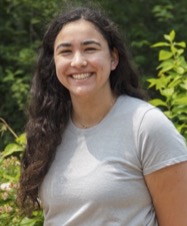
Grant Miller is from Lincoln, Nebraska and graduated with a B.S. in Chemistry from Pomona College in 2025. As an undergraduate, he conducted research in the Ball Lab at Pomona, exploring sulfur(VI) fluoride exchange (SuFEx) reactions for bioconjugation and sustainable synthesis. He also worked in the Vosburg Lab at Harvey Mudd College, where he developed safer and scalable methods for ketone synthesis using TCFH-NMI-mediated acylation. He joined the group of Prof. Dewey McCafferty at Duke University in Fall 2025. |
|
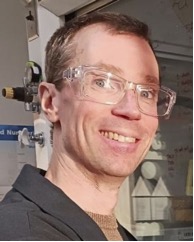
Dr. Gregory Beutner is from Wakefield, MA and graduated from Tufts University in 1998. He obtained his PhD with Prof. Scott Denmark at the University of Illinois, Urbana-Champaign. In 2004, he began an NIH post-doctoral fellowship with Prof. Robert H. Grubbs at the California Institute of Technology. He started his industrial career at Merck in 2006 before moving to his current position in Chemical Process Development at Bristol Myers Squibb in New Brunswick NJ where he is a Scientific Director and focuses on using physical organic chemistry to solve challenges in the synthesis of pharmaceutically relevant compounds. |

|
David Vosburg is the Donald A. Strauss Professor of Chemistry at Harvey Mudd College, where he has taught since 2005. He received a B.A. in Chemistry from Williams College in 1997, working with J. Hodge Markgraf. He obtained his PhD from Scripps Research in 2002 with Erik J. Sorensen as an NSF Graduate Research Fellow and was a Jane Coffin Childs Postdoctoral Fellow with Christopher T. Walsh at Harvard Medical School. David is a Henry Dreyfus Teacher Scholar and pursues organic synthesis, green chemistry, and science-faith topics. He has three children and enjoys playing games, reading, and traveling. |
|
Alana Rose Meyer is from Boca Raton, Florida and graduated with a B.S. in Biochemistry from the University of California, Los Angeles in 2022. As an undergraduate, she conducted research in the García-Garibay Lab investigating solid-state photochemical reactivity. She joined Professor Tehshik Yoon's Lab in Fall 2022 at the University of Wisconsin-Madison. Her current research focuses on the photocatalytic generation of nitrenes for use in C-N bond-forming reactions. |
|
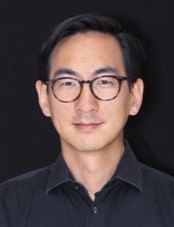
Tehshik Yoon is a Professor of Chemistry at the University of Wisconsin-Madison, where he has served on the faculty since 2005. He received his PhD from Caltech with David MacMillan (2002) and conducted postdoctoral research at Harvard with Eric Jacobsen. Tehshik has been on the faculty at UW-Madison since 2005. His research group has broad interests in the development of synthetically useful transformations promoted by visible light. |
Copyright © 1921-, Organic Syntheses, Inc. All Rights Reserved